
Advanced Engineering Plastic Stock Shapes: High-Performance Materials for Precision Industrial Components
Metal announces its failures. A shaft snaps, a bearing seizes, and the cause is usually obvious. Plastic is more forgiving, and that is exactly the problem: a poorly chosen grade can run for weeks before it creeps, swells or wears itself out of tolerance. The uncomfortable truth in most plant maintenance logs is that these parts rarely fail because the plastic was weak. They fail because the material was never matched to the job.
If you're sourcing parts for a plant, a machine shop or an OEM line, this guide will help you choose better. It covers engineering plastic stock shapes, the main materials, and how to match each one to heat, wear, chemicals and tolerance requirements.
What Are Engineering Plastic Stock Shapes?
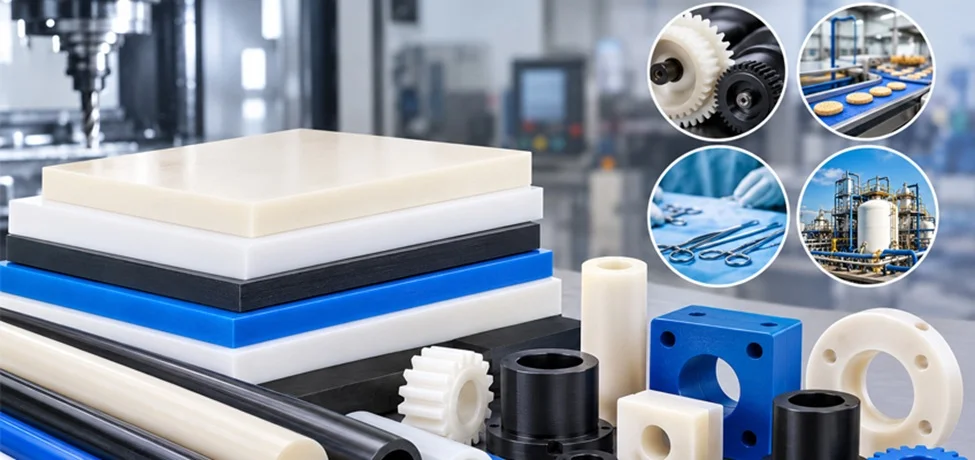
Engineering plastic stock shapes are semi-finished forms of high-performance polymers, such as rods, sheets, tubes and plates, that are machined into finished components. Instead of molding a part, you start with a solid block or bar and cut, turn, mill or drill it to size.
That's why they're popular for prototypes, low-volume runs and precision parts. There's no mold cost, lead times are short, and you can hold tight tolerances.
The most common stock shapes are:
- Plastic rods and sheets, the everyday workhorses
- Tubes and bushing stock, used for sleeves and seals
- Plates and blocks, for large structural components
Why Choose Plastic Over Metal?
Engineering plastic materials aren't a cheap substitute for steel or aluminum. In many applications, they simply perform better.
- Weight: Most are 70–85% lighter than steel.
- Corrosion: They don't rust, so wet or chemical environments are much less of a problem.
- Friction: Many run smoothly without lubrication, which suits food, medical and cleanroom settings.
- Noise and vibration: They dampen both, which makes gears and rollers quieter.
- Machinability: They cut quickly and often need no secondary finishing.
They aren't perfect. Plastics expand more with heat, are softer than metals, and some absorb moisture. Knowing these limits is what separates a good material choice from a costly one.
The Main Engineering Plastic Materials Compared
Here's a quick view before the detail. (Values are typical and vary by grade and supplier, so always check the datasheet.)
|
Material |
Best For |
Max Continuous Temp (approx.) |
Standout Property |
|
PEEK |
Extreme heat, chemicals, aerospace, medical |
~250°C |
Strength plus chemical resistance |
|
Acetal (POM) |
Gears, bushings, precision parts |
~90–100°C |
Dimensional stability, low friction |
|
Nylon (PA6, PA66) |
Wear parts, rollers, bearings |
~80–110°C |
Toughness, impact resistance |
|
UHMWPE |
Liners, wear strips, chutes |
~80°C |
Abrasion resistance, very low friction |
PEEK Rods and Sheets: When Failure Isn't an Option
- PEEK (polyether ether ketone) sits at the top of the performance pyramid. PEEK rods and sheets can handle continuous temperatures of around 250°C while resisting most chemicals, steam and radiation.
- You'll find PEEK in semiconductor equipment, aerospace components, oil and gas seals, and surgical or dental instruments. It also stands up to repeated sterilization.
The catch is price. PEEK costs many times more than commodity plastics, so use it where cheaper materials would fail, not where they'd merely do fine.
Acetal Plastic Rods: The Precision Favorite
Acetal, also called POM, is probably the most widely machined engineering plastic. Acetal plastic rods offer excellent dimensional stability, low friction and high stiffness, which makes them ideal for precision gears, bushings, valve parts and fasteners.
It absorbs very little moisture, so parts stay on size in humid conditions. Two types matter:
- Homopolymer: stiffer and stronger, with better wear properties
- Copolymer: better chemical resistance and hot-water performance
If your part needs tight tolerances and the environment isn't extreme, acetal is usually the sensible first choice.
Nylon Plastic Sheets and Rods: Tough and Versatile
Nylon is the go-to for parts that take repeated impact and abrasion. Nylon plastic sheets and rods combine toughness, good wear resistance and vibration damping at a moderate cost.
You'll see them as rollers, wear pads, gears, sprockets and structural spacers. Cast nylon is popular for large, heavy-duty parts. Oil-filled and MoS₂-filled grades add self-lubrication.
One caution: nylon absorbs moisture, which can swell parts slightly and soften them. If tolerance matters, account for this in your design or pick a stabilized grade.
UHMWPE Sheets and Rods: The Wear Champion
- Ultra-high molecular weight polyethylene is a bit of a quiet hero. UHMWPE sheets and rods have outstanding abrasion resistance, extremely low friction and excellent impact strength, even at low temperatures.
- That's why they line hoppers, chutes and conveyor guides, and appear in food processing and material handling. Materials slide off them rather than stick.
Its limits are heat (about 80°C continuous) and lower stiffness. It isn't the right material for precision, load-bearing parts at elevated temperatures.
How to Choose the Right Material: 5 Questions to Ask
Before you send an order, ask yourself:
1. What's the operating temperature? Pushing past a material's limit is the most common mistake.
2. What's the wear scenario? Sliding, abrasion and impact each favor different plastics.
3. What chemicals will it touch? Check compatibility, not just general resistance.
4. How tight are the tolerances? Low moisture absorption and stable materials like acetal and PEEK win here.
5. What's the budget over the part's whole life? A pricier material that lasts five times longer is usually cheaper.
Which Is Best for Wear Resistance?
For wear-resistant engineering plastics, UHMWPE leads in abrasion, nylon in general sliding wear and impact, and PEEK in high-temperature wear. Filled grades, such as those with carbon fiber, glass or lubricants, push performance further.
Which Is Best for Chemical Resistance?
For chemical-resistant plastic materials, PEEK and PTFE are the strongest overall, with UHMWPE and acetal copolymer excellent in many common environments. Strong oxidizing acids can damage acetal and nylon, so always check the exact chemical, concentration and temperature.
Real-World Applications of Industrial Plastic Stock Shapes
Industrial plastic materials show up almost everywhere:
- Food and beverage: FDA-compliant acetal and UHMWPE for guides, wear strips and cutting surfaces
- Automotive: nylon and acetal for bushings, fuel system parts and gears
- Medical: PEEK for implants and sterilizable instruments
- Semiconductor: high-purity PEEK and PTFE for wafer handling
- Mining and bulk handling: UHMWPE liners that cut sticking and wear
- Packaging and automation: acetal and nylon for star wheels, rollers and guide rails
Tips for Machining Precision Plastic Components
Getting good precision machined plastic components takes a slightly different approach than metal.
- Keep tools sharp. Dull tools generate heat, and plastic doesn't dissipate it well.
- Manage heat and stress. Use light cuts and proper coolant. Stress-relieve large parts before final machining.
- Allow for expansion. Plastics move with temperature, so measure at stable room conditions.
- Choose annealed stock when tolerances are tight, since it's less likely to warp after cutting.
- Buy from suppliers who provide traceability and material certificates, especially for medical and food applications.
Common Mistakes to Avoid
- Picking by price alone, then replacing the part three times
- Ignoring moisture absorption in nylon
- Using acetal where strong acids are present
- Forgetting thermal expansion in close-fit assemblies
- Over-specifying PEEK when acetal or nylon would work fine
Frequently Asked Questions
What are engineering plastic stock shapes used for?
They're machined into finished parts such as gears, bushings, bearings, seals, insulators, wear strips and structural components across many industries.
What's the difference between engineering plastics and commodity plastics?
Engineering plastics have higher strength, heat resistance, wear resistance and dimensional stability. Commodity plastics like polyethylene or polypropylene suit everyday, low-stress uses.
Is PEEK worth the cost?
Yes, when you need high temperature, chemical, or sterilization resistance and failure is expensive. For milder conditions, acetal or nylon is usually more economical.
Can plastic rods and sheets replace metal parts?
Often, yes. In bearings, gears, bushings, liners and insulators, plastics can reduce weight, noise and maintenance. They're less suitable where very high loads or temperatures apply.
Which engineering plastic is best for gears?
Acetal and nylon are the most common. Acetal offers precision and low friction; nylon offers toughness and impact absorption. PEEK is used for demanding, high-temperature gears.
How do I get precise tolerances in plastic parts?
Choose a dimensionally stable material, use annealed stock, machine with sharp tools, and measure at controlled temperature.
Final Thoughts
Engineering plastic stock shapes give manufacturers speed, flexibility and strong performance without the weight and corrosion issues of metal. The trick is matching the material to the job: PEEK for the extremes, acetal for precision, nylon for toughness, and UHMWPE for wear.
Get that match right, and your components run longer, quieter and cheaper over their lifetime.
 Media Pack Download
 Newsletters
 Industrial Events