Role of Chemical Additives in Thermal Injection Molding Processes
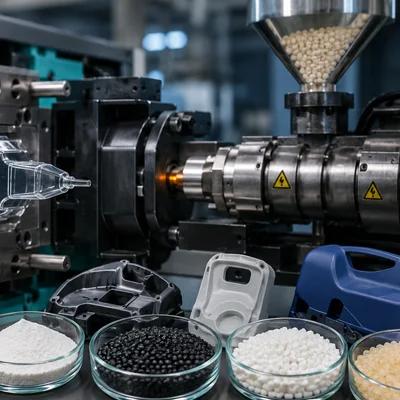
One of those manufacturing processes that can look simple at the surface, but can be quite sensitive when you get into it on the shop floor, is thermal injection molding. You take a polymer, put it into a mold, cool it and it becomes a part. In fact, if there are slight differences in material characteristics, the part may be accepted or rejected.
That’s where chemical additives in injection molding quietly become important. Most of the time they don’t get attention, but without them, consistent production would be difficult, especially for engineering-grade plastics.
Why additives matter more than people assume
If a polymer is subjected to high pressure and pushed through a screw while under heat, it ceases to be a solid and becomes a polymer paste. It gets temperature, shear and time sensitive.
Without support from plastic processing additives, you typically start seeing problems like:
- melt degradation during long cycles
- uneven flow into thin sections
- surface dullness or flow marks
- parts warping after ejection
- inconsistent mechanical strength
The additives actually decrease this unpredictability. What they do not replace the base resin with, they do make it behave in a more controlled manner when processing.
Thermal stabilizers for polymers
If there’s one additive category that almost every formulation depends on, it’s thermal stabilizers for polymers.
During thermal injection molding, the material is exposed to heat longer than most people realize. Not only is the barrel temperature important, but also shear heating within the barrel in the screw.
If stabilizers are not used, the polymer chains begin to break down. It may not be apparent at first, but will manifest as discoloration, brittleness, or odor changes in the last section over time.
Stabilizers slowdown that degradation. In simple terms, they give the material a longer “safe processing window,” which makes production less risky.
Plastic flow modifiers and how they change processing behavior
Flow is one of those things operators often judge visually—how quickly the mold fills, whether pressure spikes happen, or if the machine feels stable.
Plastic flow modifiers help smooth out that behavior.
Instead of the melt resisting movement, it flows more evenly through the cavity. This is especially useful in complex molds where thin ribs or long flow paths exist.
In practice, you usually notice:
- fewer short shots
- reduced injection pressure fluctuations
- better surface consistency
- easier filling of multi-cavity tools
It’s not dramatic in isolation, but on a production line it makes things feel “easier.”
Mold release additives
Anyone who has worked with injection molding long enough has dealt with parts sticking in the mold. Sometimes it’s occasional, sometimes it becomes a recurring issue.
Mold release additives reduce that friction between the polymer and the mold surface.
Instead of relying only on external sprays, the material itself becomes easier to demold. That means:
- less force during ejection
- lower risk of part deformation
- fewer cycle delays
- less wear on mold surfaces
Over time, this also improves tool life, which is a big cost factor in high-volume production.
Impact modifiers in plastics
Some polymers are naturally rigid but brittle. They look strong but crack easily under sudden force.
Impact modifiers in plastics are added to address exactly that weakness.
They introduce a softer phase inside the rigid structure. So when the material is hit or stressed suddenly, the energy gets absorbed instead of forming cracks.
You’ll see this used heavily in:
- automotive interior trims
- protective housings
- industrial covers and panels
It’s one of those additives that doesn’t change how the part looks, but completely changes how it behaves in real use.
Polymer processing aids
Not all additives are about the final product. Some are about keeping the process stable.
Polymer processing aids fall into that category.
They help reduce issues like melt fracture, die buildup, or unstable flow at higher speeds. In continuous production, this becomes important because even small interruptions affect output.
You don’t always “see” their effect directly, but you notice it in reduced maintenance and fewer production stoppages.
How material enhancement actually happens
In real applications, no one uses just one additive and expects miracles. It’s usually a combination.
For example, a formulation might include:
- a stabilizer for heat resistance
- a flow modifier for filling behavior
- an impact modifier for toughness
- a processing aid for stability
Each one adjusts a different part of the material’s behavior.
This is what people usually mean when they talk about injection molding material enhancement—it’s not a single improvement, but a balance of multiple properties.
What counts as “best” additives?
There isn’t really a universal answer to that.
The best chemical additives for enhancing plastic molding quality depend entirely on what you’re trying to achieve. A packaging film doesn’t need the same formulation as an automotive structural part.
That said, most industrial setups repeatedly rely on the same core groups:
- thermal stabilizers for polymers
- plastic flow modifiers
- mold release additives
- impact modifiers in plastics
- polymer processing aids
The difference is not in which additives are used, but how they are tuned and combined.
The direction the industry is moving
There's another change in additive development too.
Manufacturers are now caught between the need to cut emissions, increase their ability to recycle and keep performance level. This has led to the development of new additives that have:
- lower dosage requirements
- better compatibility with recycled resins
- reduced environmental impact
- improved efficiency in processing
So the focus is slowly moving from “more additive = better performance” to “smarter formulation with less material.”
Final thoughts
The term chemical additives in injection molding is not only used to refer to the substances used as auxiliary materials for the process but also to the constituents that enable the use of plastic in today's world.
They are absolutely crucial for thermal injection molding to be stable, consistent, and easy to control on a large scale.
Each of the above materials has a specific function in making the process reliable, whether used as thermal stabilizers in polymers, plastic flow modifiers, mold release additives, or impact modifiers in plastics.
And in real manufacturing environments, reliability matters more than anything else.
 Media Pack Download
 Newsletters
 Industrial Events