Sustainable Additives and Masterbatches: Enabling Circular Plastics and High-Recycled Content Manufacturing
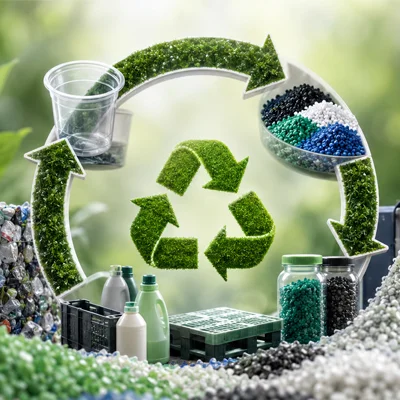
For years, recycled plastics were viewed as a compromise—good for sustainability targets but often poor in consistency, aesthetics, and performance. That perception is rapidly changing. Today's sustainable additives and advanced masterbatch technologies are transforming recycled polymers into reliable engineering materials capable of meeting demanding industrial requirements. From improving processability and restoring polymer properties to enabling premium appearance and regulatory compliance, innovative additive solutions are making high recycled content plastics commercially viable across industries.
As manufacturers pursue ambitious circular economy goals, additives are no longer supporting materials—they have become strategic technologies that bridge sustainability and performance.
The Circular Economy Isn't Limited by Recycling—It's Limited by Material Performance
Across the plastics value chain, sustainability ambitions are accelerating faster than material capabilities.
Brands are announcing ambitious recycled content targets. Governments are introducing Extended Producer Responsibility (EPR) regulations. OEMs are demanding lower carbon footprints from suppliers. Consumers increasingly expect packaging and products to contain recycled content.
Yet one challenge continues to surface inside manufacturing facilities:
"How do we produce premium-quality products using materials that are inherently inconsistent?"
Every recycling cycle changes polymer behavior.
Heat history reduces molecular weight. Contamination affects appearance. Multiple processing cycles decrease impact resistance. Moisture introduces defects. Color inconsistency limits premium applications.
Without intervention, these factors prevent manufacturers from increasing recycled content.
This is where Sustainable additives for recycled plastics have evolved from optional processing aids into essential technologies that restore confidence in recycled materials.
Instead of simply modifying polymers, modern additive systems rebuild performance lost during recycling—allowing manufacturers to push recycled content far beyond previous limitations.
Why High-Recycled Content Plastics Need More Than Good Intentions
Using 10% recycled resin is relatively straightforward.
Using 50%, 70%, or even 100% recycled material is a completely different engineering challenge.
Each batch of PCR plastics (Post-Consumer Recycled Plastics) tells a different story.
Different collection streams.
Different polymer grades.
Different contamination levels.
Different degradation histories.
For production managers, this variability creates operational uncertainty.
Extrusion stability fluctuates.
Injection molding cycle times change.
Mechanical properties become unpredictable.
Color shifts between production lots.
Surface finish deteriorates.
Manufacturers cannot simply increase recycled resin percentages and expect identical product performance.
Instead, they require intelligent material optimization.
Today's High recycled content plastic additives compensate for these inconsistencies by stabilizing polymer chains, improving melt flow behavior, enhancing compatibility between mixed polymers, and restoring mechanical integrity.
Rather than masking recycled material limitations, they actively improve material functionality.
Masterbatches Are Becoming Material Engineering Platforms
Traditionally, masterbatches were associated with coloration.
Black masterbatch.
White masterbatch.
Special effect colors.
That definition is becoming outdated.
Today's leading masterbatch manufacturers are developing multifunctional solutions that combine aesthetics, processing optimization, durability enhancement, recycled-content compatibility, and sustainability objectives within a single formulation.
Modern masterbatch technologies may simultaneously deliver:
- Color consistency
- UV stabilization
- Odor reduction
- Processing improvements
- Anti-scratch properties
- Mechanical reinforcement
- Recycled polymer stabilization
- Regulatory compliance
This convergence allows manufacturers to reduce formulation complexity while improving production efficiency.
Instead of purchasing multiple additive packages, processors increasingly adopt integrated masterbatch solutions tailored to specific applications.
The result is simpler production, better quality control, and faster product development.
Recycled Plastic Additives Are Restoring Value Lost During Recycling
Mechanical recycling inevitably changes polymer chemistry.
Repeated heating breaks molecular chains.
Oxidation weakens performance.
Moisture accelerates degradation.
Contaminants introduce defects.
Without corrective technologies, recycled plastics gradually lose commercial value.
Modern recycled plastic additive technologies address these issues throughout the processing cycle.
Chain extenders reconnect degraded molecular structures.
Processing stabilizers reduce thermal degradation.
Impact modifiers restore toughness.
Compatibilizers improve mixed-polymer performance.
Antioxidants extend material lifespan.
These technologies enable recycled materials to perform closer to virgin resin standards while supporting more demanding industrial applications.
Instead of being restricted to low-value products, recycled polymers are increasingly entering automotive components, electronics, industrial packaging, consumer appliances, and durable goods.
The Rise of PCR Plastic Masterbatch Solutions
Among all recycled material categories, PCR plastics (Post-Consumer Recycled Plastics) present the greatest opportunity—and the greatest challenge.
Unlike post-industrial waste, PCR materials originate from consumer products with highly variable histories.
Packaging.
Household goods.
Consumer electronics.
Personal care containers.
Food packaging.
Each source contributes unique contamination profiles and processing characteristics.
To address this complexity, PCR plastic masterbatch solutions are becoming increasingly specialized.
Rather than generic formulations, manufacturers now design masterbatches specifically optimized for recycled polyethylene, polypropylene, PET, ABS, and engineering plastics.
These tailored solutions help manufacturers achieve:
- Better color repeatability
- Reduced yellowing
- Improved odor control
- Enhanced dispersion
- Better mechanical consistency
- Improved processing stability
Such improvements allow converters to confidently increase PCR content without sacrificing product quality or customer expectations.
Biodegradable Masterbatch Is Expanding Sustainable Material Choices
Recycling represents one pathway toward sustainability.
Biodegradable materials represent another.
As compostable packaging and bio-based polymers gain commercial traction, demand for biodegradable masterbatch technologies continues to grow.
Traditional additives often fail to perform effectively within compostable polymer systems.
Biodegradable masterbatches are specifically engineered to maintain compatibility while preserving compostability requirements.
These solutions enable manufacturers to introduce:
- Color effects
- UV protection
- Anti-static performance
- Processing optimization
- Functional enhancements
without compromising environmental objectives.
Rather than replacing recycling, biodegradable solutions broaden the sustainable material portfolio available for applications where compostability offers greater environmental benefits.
Bio-Based Masterbatch Solutions Are Redefining Sustainable Formulations
Sustainability is no longer evaluated solely by recycled content.
Customers increasingly assess the carbon footprint of every ingredient incorporated into plastic products.
This shift has accelerated innovation in Bio-based masterbatch solutions.
Instead of relying exclusively on fossil-derived carriers, manufacturers are exploring renewable raw materials sourced from biomass and other sustainable feedstocks.
Combined with renewable pigments and environmentally preferable additives, these masterbatch systems help reduce lifecycle emissions while supporting corporate ESG commitments.
Although bio-based formulations are still evolving, they represent an important step toward reducing dependence on petrochemical resources without compromising manufacturing efficiency.
Circular Economy Additives for Polymers Enable Closed-Loop Manufacturing
The future of plastics is no longer linear.
Produce.
Use.
Dispose.
Instead, industries are building systems where materials continuously circulate through multiple life cycles.
However, each recycling loop introduces new performance challenges.
This is why Circular economy additives for polymers have become foundational technologies for closed-loop manufacturing.
They help preserve polymer quality across repeated processing cycles by:
- Minimizing degradation
- Improving compatibility
- Enhancing processing stability
- Maintaining appearance
- Supporting multiple recycling loops
Instead of accepting quality losses after every recycling cycle, manufacturers can retain greater material value throughout the product lifecycle.
This dramatically improves the economics of circular plastics while reducing dependence on virgin resin.
Plastic Recycling Additives Are Making Premium Applications Possible
Historically, recycled plastics were primarily used in low-performance applications.
Garbage bags.
Construction products.
Utility components.
Today, plastic recycling additives are enabling recycled materials to enter premium market segments.
Automotive interiors require dimensional stability.
Consumer electronics demand attractive surface finishes.
Food-contact packaging requires stringent compliance.
Household appliances require long-term durability.
Meeting these requirements with recycled polymers would have been difficult only a decade ago.
Advanced additive technologies now bridge the performance gap between recycled and virgin materials, opening new commercial opportunities for recycled resin producers and product manufacturers alike.
Sustainable Plastic Manufacturing Requires Collaboration Across the Value Chain
No single organization can build a circular plastics ecosystem alone.
Recyclers improve material quality.
Compounders develop customized formulations.
Masterbatch manufacturers engineer advanced additive technologies.
OEMs define product performance requirements.
Brand owners establish sustainability targets.
Machine manufacturers optimize processing equipment.
Together, these stakeholders are transforming sustainable plastic manufacturing from a corporate aspiration into an operational reality.
Increasingly, additive suppliers participate during early product development rather than after material selection.
This collaborative approach allows manufacturers to optimize recycled content, processing efficiency, product performance, and sustainability simultaneously.
Data-Driven Material Development Is Accelerating Innovation
Artificial intelligence, digital twin technologies, and advanced material characterization tools are changing how additive formulations are developed.
Instead of relying solely on traditional trial-and-error experimentation, developers can now model polymer interactions digitally.
Machine learning identifies formulation patterns.
Predictive analytics estimate long-term performance.
Simulation reduces product development timelines.
These technologies accelerate innovation while allowing additive companies to create customized solutions for increasingly complex recycled material streams.
The future of additive development will likely become even more application-specific, with formulations optimized for individual recycling processes and end-use environments.
The Next Competitive Advantage Will Be Material Intelligence
The plastics industry has reached an important turning point.
Competitive differentiation is no longer defined only by production capacity or resin availability.
Increasingly, success depends on how intelligently manufacturers manage materials.
Companies capable of processing high recycled content plastics without compromising quality will gain significant advantages in cost, compliance, customer trust, and sustainability performance.
Achieving that balance requires more than recycled resin alone.
It requires sophisticated additive technologies that restore, stabilize, protect, and enhance polymer performance throughout multiple product lifecycles.
From advanced recycled plastic additive systems and specialized PCR plastic masterbatch solutions to innovative Bio-based masterbatch solutions, the industry is building materials that are designed not simply to be recycled—but to remain valuable every time they return to production.
The future of circular economy plastics will therefore depend less on the availability of recycled material and more on the technologies that make recycled materials perform like premium ones.
In that future, sustainable additives and masterbatches won't just support circular manufacturing—they will define it.
 Media Pack Download
 Newsletters
 Industrial Events