CNC Machining of Plastic Stock Shapes: Improving Precision, Dimensional Stability and Material Efficiency
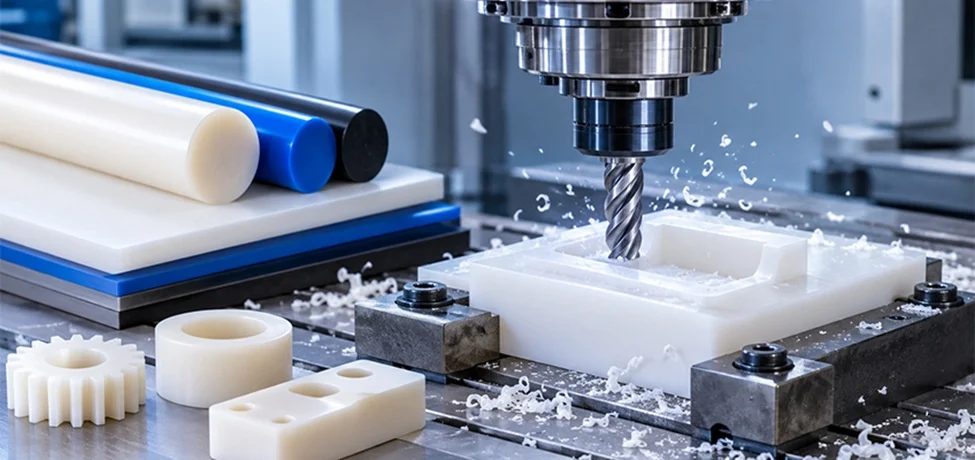
CNC machining plastic stock shapes can hold tight tolerances and repeat them part after part, but only if you control three things: the stress locked inside the material, the heat you put into it, and how much of the bar or sheet ends up in the scrap bin. Get those right and most engineering plastics will hold ±0.05 mm, stay flat and round after they leave the machine, and waste far less material. Here is how, in plain shop language.
Quick answers
- Typical tolerance: ±0.05 to ±0.1 mm on most plastics. Stable grades like acetal and PEEK can reach ±0.025 mm with good control.
- Preventing warping: use stress-relieved stock, remove material evenly from both sides, keep tools sharp, keep heat low, and let the part rest before the finish pass.
- Cutting waste: match stock size to the part, nest parts on sheets, and track every offcut.
What are plastic stock shapes, and why machine them?
Plastic stock shapes are the semi-finished rods, bars, sheets, plates and tubes that manufacturers extrude or cast for machinists. Instead of paying for a mold, you start with a length of nylon, acetal (POM), UHMW-PE, PEEK, PTFE or polycarbonate and cut the part out of it.
That makes plastic stock shape machining a good fit for prototypes, short runs, and large or thick parts that are awkward to mold. Design changes cost you a new program, not a new tool.
The catch is that plastic behaves nothing like aluminum. It is softer, it grows and shrinks with temperature, and some grades soak up water. Machining engineering plastics the way you machine metal is the root cause of most scrapped parts.
How tight can plastic CNC machining tolerances get?
Plastic CNC machining tolerances depend far more on the material than on the machine. These are approximate shop-practice figures for well-supported parts of moderate size; geometry, wall thickness and supplier all shift them.
|
Material |
Typical tolerance (mm) |
What to know |
|
Acetal (POM) |
±0.05 |
Low moisture uptake and clean chips. The benchmark for precision. |
|
PEEK |
±0.025 to ±0.05 |
Excellent thermal and dimensional stability, but expensive. |
|
Polycarbonate |
±0.05 to ±0.1 |
Stable, but some coolants can cause stress cracking. |
|
Nylon (PA6, PA66) |
±0.1 |
Absorbs moisture and swells. Allow for conditioning. |
|
PTFE |
±0.1 to ±0.15 |
Very soft and creeps under clamping force. |
|
UHMW-PE |
±0.15 |
Springy, with high thermal expansion. |
A practical rule: call out tight tolerances only on the features that need them. Every extra tight dimension adds inspection time and raises the scrap risk.
Why do plastics move? Understanding dimensional stability
The dimensional stability of plastics comes down to four things.
- Thermal expansion. Many plastics expand five to ten times more than steel. A 200 mm acetal part that is 10 °C warmer is roughly 0.2 mm longer. That alone can break a ±0.05 mm tolerance.
- Moisture absorption. Nylon can take up a couple of percent of its weight in water in humid air, and it swells as it does. Acetal and PEEK barely react.
- Residual stress. Extruded rod and thick plate cool from the outside in, which locks stress into the core. Cut into it, and the part relaxes into a new shape.
- Creep. Under steady load, such as a tight clamp, plastic slowly deforms and does not fully recover.
So the fix is partly process and partly planning. Let stock acclimatise in the shop before cutting, inspect at a standard temperature (around 20 to 23 °C), and pick a stable material when the tolerance is tight. If a nylon part must hold size in service, tell your machinist its working environment up front.
How to prevent warping when machining plastic
Warping is almost always stress or heat finding a way out. Work through these steps in order.
1. Start with stress-relieved stock. Ask your supplier for annealed material. For critical parts, anneal again after roughing.
2. Rough, rest, then finish. Leave about 0.3 to 0.5 mm on every face, let the part relax for a few hours, then take light finishing passes.
3. Remove material evenly. On a sheet, alternate between faces instead of cutting one side to full depth. Uneven removal is the classic cause of bowing.
4. Keep heat out. Use sharp, polished tools, a high spindle speed, a moderate feed and good chip evacuation. An air blast or a compatible coolant helps. Gummy, melted chips mean you are too hot.
5. Clamp lightly and support widely. A vacuum table or soft jaws spread the load. Heavy clamping deforms the part, which then springs back when released.
6. Use the right cutter. Single or two-flute tools with positive rake and large chip gaps cut cleanly. Dull tools rub, and rubbing makes heat.
7. Measure when the part has settled. Check it once it has cooled and returned to room temperature, not straight off the machine.
Machining plastic sheets and rods: what changes
Rods. Round stock is cooler on the outside than at the core, so a bar can bend slightly once you turn away the skin. Rough-turn first, rest it, then finish. Use a steady rest on long, slender parts, and support thin-wall tubes with a mandrel so they do not collapse under the cutter.
Sheets and plates. Flatness is the main concern. Hold sheets on a vacuum table, cut with tabs so nested parts do not shift, and machine both faces. For thick plate, cast grades are often more stable than extruded ones because they carry less internal stress.
In both cases, buy stock a little oversize. Plastic needs finishing allowance to clean up whatever the material does when you open it up.
How to reduce material waste in CNC machining
CNC machining material efficiency starts before the spindle turns. Plastic stock is expensive, and the biggest waste is usually not chips. It is the oversized bar, the half-used sheet and the part scrapped by warping.
- Match stock to the part. Check the supplier's standard diameters and thicknesses first. A part that needs 52 mm can often be cut from 55 mm rod instead of 60 mm. If the design allows, nudge a dimension to suit a standard size.
- Nest sheet parts tightly. Nesting software packs parts closer together. Shared edges and common toolpaths save both material and cycle time.
- Get the first part right. Scrap is the most costly waste, so the warping steps above are also your best material-saving plan.
- Track every offcut. Label remnants by material, grade, colour and thickness. Use them for fixtures, test cuts, prototypes and small parts.
- Keep chips sorted. Clean, single-polymer scrap can be recycled. Mixed or oily scrap usually cannot.
- Batch similar jobs. Running the same material together means fewer half-used bars sitting on the rack.
Frequently asked questions
Which plastics are best for precision machining?
Acetal and PEEK are the usual choices. Both are dimensionally stable and machine cleanly. Polycarbonate is a good middle option.
Can CNC machining hold ±0.01 mm on plastic?
Rarely, and only on small, stable features in a controlled environment. For most plastic parts, plan on ±0.05 mm or looser.
Do I need coolant?
Not always. Many plastics cut well with an air blast. If you use liquid, confirm it is compatible with the polymer, since some cause stress cracking.
Why did my nylon part change size after machining?
Usually moisture. Nylon swells as it absorbs water, so condition the part, or choose acetal or PEEK for tight-tolerance work.
Is machining cheaper than injection molding?
For low and medium volumes, yes, because there is no mold cost. At thousands of parts, molding usually wins.
The bottom line
Precision in plastic is earned before the first cut: stable stock, sensible tolerances, cool cutting and tight material planning. Do those well and you will see fewer rejects, steadier dimensions and less plastic in the bin.
 Media Pack Download
 Newsletters
 Industrial Events