
Cost Optimization Strategies and Efficiency Tips for Plastic Manufacturers
Introduction: The New Economics of Plastic Manufacturing
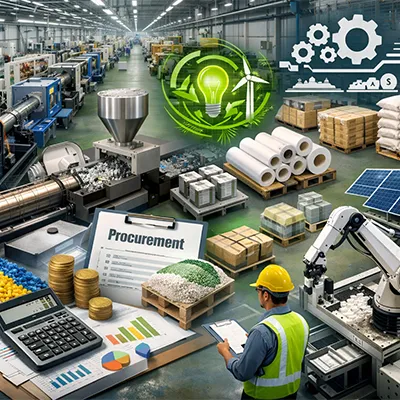
The financial environment of the plastics industry is also changing due to the rising costs of energy, the unstable markets of raw materials, the pressure of regulations and the growing demands of customers. In the modern world, the management of plastic production prices is not only a financial goal but also a strategic requirement. In the case of manufacturers that exist in the global markets characterized by high competition, the capacity to synchronize plastic production efficiency to sustainable growth is the difference between long term success and failure.
Cost optimization in the plastics industries today transcends beyond minimization of overheads. It must involve a systematic methodology that incorporates procurement strategy, energy management, process engineering, workforce productivity and digital monitoring systems. This plastic manufacturing cost control and efficiency guide is a comprehensive business guide of the actionable cost reduction strategies to be implemented by plastic manufacturers in the B2B industrial settings.
Understanding the Core Cost Drivers in Plastic Manufacturing
Manufacturers need to know the driving factor in cost of plastic manufacturing before putting the optimization strategies in place. The costs may broadly be classified into five big groups namely raw materials, energy consumption, labor, maintenance and logistics.
Raw materials take up 50-70 percent of total cost of production, particularly in injection molding and extrusion processes. The resin prices fluctuate depending on the margins. The second-largest cost is energy consumption, which is used especially in high-temperature processes. Profitability is also affected by labor, equipment depreciation, scrap rates and downtime.
Plastic plants management should start with the clear cost mapping. By using cost breakdown structures at the level of processes manufacturers can much more precisely identify inefficiencies and focus improvement efforts on the areas that cause changes to financial results that can be measured.
Material Procurement and Cost Optimization in Plastics Industry
One of the most important risks in plastic manufacturing is the volatility of the raw materials. In the plastics industry operation, strategic sourcing is a major consideration in terms of material acquisition and cost reduction.
Contracts with resin suppliers can be long-term so that in times of market fluctuations the prices will be stable. But flexibility should be ensured so that there are chances of utilizing spot market opportunities in the event of low prices. Supplier diversification eliminates risks of dependency and enhances bargaining power.
The new and highly developed procurement strategies involve the use of data-driven forecasting that utilizes past consumption and production programs as well as demand patterns. With the production planning and procurement aligned, companies ensure that the cost of excess inventory carrying is minimized besides avoiding the stockout that interferes with production.
The recycling and the regrind use is also a good opportunity to save costs. The scrap recovery process within the company is optimized to reduce the use of virgin material without using one that leads to reduced product quality. Manufacturers who invest in material traceability systems stand in a better position to sustain the compliance and minimise on waste.
Lean Operations in Plastic Production
Lean in the plastic production aims at eradicating waste within the value chain. The wastes in plastic plants are normally manifested in over production, waiting time, unnecessary movement, defects and energy wavers.
One of the most effective improvements is cycle time optimization. Minimal changes in the output can boost yield by a significant percentage even with no extra capital expenditure. Injection, cooling, and ejection stages are some of the bottlenecks that should be determined through time-and-motion studies by process engineers.
Work standardization minimizes variations in the industrial plastics processes. Proper documentation of the processes guarantees the quality of the processes and reduction of rework. The visual production management systems enable the supervisors to identify deviations early enough and act in advance.
Continuous improvement cultures are also promoted in lean manufacturing. Involving shop-floor employees in problem-solving efforts makes them more accountable and more efficient solutions to problems, which would not be realized by the management.
Plastic Plant Energy Efficiency Techniques
Energy is also a very crucial factor in the cost of plastic manufacturing particularly in energy intensive processes, extrusion, thermoforming and blow molding. The application of energy efficiency in plastic plant techniques can produce short and long-term financial gains.
Pumps and conveyors consume less electricity which is minimized by upgrading to energy efficient motors and variable frequency drives. During advanced barrel heating systems with an improved level of insulation reduce thermal losses. Energy monitoring systems are used to check real-time consumption, and aberrant consumption patterns will be detected and corrective measures can be taken before costs become crippling.
Plastic plants are often characterized by compressed air systems which are inefficiencies. Frequent leak audit and pressure optimization can save a lot of energy wastage. Machine waste heat recovery systems (which misapplied) to preheat materials or heat facilities also increase the efficiency of the whole plant.
Energy benchmarking across the shifts and production lines allows the management to contrast the performance and aspects that are not performing. Establishing a balance between cost management and sustainability objective enhances environmental compliance and financial performance.
Automation and Smart Manufacturing for Productivity Gains
Automation has a revolutionary part in the plans to enhance productivity in the plastic manufacturing plants. Material handling, part removal, and packaging robotics minimize the involvement of people and increase consistency.
Smart sensors in machines check on parameters like pressure, temperature and vibration. Such data streams can be utilized in predictive maintenance models, which will reduce untimely downtimes. Reduction of downtime is directly related to increased efficiency in plastic production and decreased costs of operation.
Execution systems involve the production scheduling, inventory management, and quality management all in a single set of digital solutions. These systems are able to give visibility to the industrial plastics operations, and thus real time adjustments can be made to ensure that they perform optimally.
Although automation demands initial outlay, the benefits of investment can be realized in terms of cost of labor, minimized errors and increased throughput.
Maintenance Strategies for Cost Control
Plastic manufacturing costs are considerably high with unexpected downtime. In the competitive industrial world, reactive maintenance methods can no longer be viable.
Preventive maintenance schedules maintain machinery in perfect conditions. Predictive maintenance with the help of condition-monitoring technologies identifies possible failures prior to their interference with the working process. This will lower the inventory of the spare parts and increase the life span of the equipment.
Organized maintenance system in the management of plastic plants must incorporate a system that monitors equipment performance, root cause analysis of system breakdown and continuous improvement loop. Good maintenance minimizes the scrap rates, and ensures quality products at a constant rate, which goes directly to cost-reduction measures of plastic companies.
Workforce Optimization and Skill Development
Efficiency of labor is also an important component of industrial manufacturing cost control and efficiency guide paradigms of plastic manufacturing. Experienced operators can adjust the settings of the machines in order to minimize scrap and cycle times.
Training employees across board enhances flexibility in operations. As the workforce versatility is enhanced, manufacturers are able to make alterations in production schedules, without paying overtime or adding more employees.
Accountability is promoted through performance-based incentive systems that are related to productivity and quality goals. It also cuts down costs when safety training is done indirectly as accidents that cause downtime and compensation costs are avoided.
Supply Chain and Logistics Optimization
The cost structures are also implemented through efficient steel mold management, transportation planning and finished goods distribution. Optimal warehouse designs ensure less time is taken in material movements and the accuracy of inventory.
Together with B2B customers, collaborative forecasting maintains the stability of demand. Manufacturers do not incur the overproduction and the costs of inventory storage since the production schedules are very close to the demand of customers.
Digitization in supply chain improves transparency as well as administration overhead. ERP systems also facilitate procurement processes, production, and distribution processes and enhance the steel procurement and supply chain risk mitigation measures in plastics settings.
Cost Optimization Impact Matrix
| Cost Area | Optimization Strategy | Expected Impact |
| Raw Materials | Long-term contracts and regrind use | 5–15% reduction in material costs |
| Energy | Variable frequency drives and heat recovery | 10–25% energy savings |
| Labor | Automation and cross-training | 8–20% productivity increase |
| Maintenance | Predictive monitoring systems | 15–30% reduction in downtime |
| Inventory | Demand-driven planning | 10–18% reduction in carrying costs |
This table explains how departmental coordinated efforts would play a major role in improving efficiency in plastic production.
Step-by-Step Framework for Plastic Cost Optimization
To begin with, have a total audit of cost in terms of materials, energy, labor and overhead. Second, the benchmark performance rate in terms of cycle time, scrap rate and energy per unit produced. Third, focus on high-impact areas of improvements depending on their financial potential and possibility. Fourth, introduce pilot projects that will justify anticipated savings. Lastly, make successful activities an institution with the help of standard operating procedures and digital monitoring.
This systematic approach will guarantee that there are quantifiable upgrades as opposed to single cost-reduction efforts.
Frequently Asked Questions
What is the most effective way to reduce plastic manufacturing costs?
The procurement process is optimized, the lean process is optimized and the energy management is combined so as to generate the most sustainable results. Concentration on a single area limits the potential of saving in general.
How can small and mid-sized plastic manufacturers improve plastic production efficiency without large capital investments?
Cycle times, preventive maintenance, scrap rates, and training programs of the workforce may yield huge profits without spending much money.
Is automation necessary for industrial plastics operations?
Although optional, automation has a strong positive effect on consistency, labor expenses, and long-term scalability particularly in the highly-volume B2B production setting.
Building a Culture of Continuous Improvement
The best approach to cost reduction of plastic manufacturers occurs when in-built in the organizational culture. Leadership dedication is needed to make sure that there is congruence between the financial targets and operational practices.
The key performance indicators are to be revised on a regular basis. Clear communication of the performance information stimulates the involvement of the employees and their responsibility. Sustainable efficiency gain is achieved through continuous improvement programs which are assisted by cross-functional teams.
Plastic plant control should also combine environmental compliance and cost reduction programs. Compliance with the rules, waste minimization and energy savings advance brand reputation and decrease the risk.
Conclusion: Sustainable Profitability through Integrated Optimization
Plastics is a highly competitive industry that cannot be advanced in a gradual manner. The key to the sustainable profitability is the integrated strategies that would concern the material procurement and cost optimization in the supply chain of the plastic industry, the lean operations in the plastic production, the innovative energy management, and the digital transformation.
Companies can also help achieve high quality and reliability of output by applying systematic measures that will increase the productivity of plastic manufacturing plants at a very low cost. The perfect industrial plastic manufacturing cost control and efficiency guide is not only a cost reduction tool but a value maximization tool at all the levels of the industrial plastics operations.
Those manufacturers that embrace the use of supporting data to make decisions, invest in the development of their workforce, and constantly optimize their processes will not collapse under the influence of the volatile market. In an industry where margins are low and demand fluctuates, the only thing that is not mandatory is efficiency, which is the core of long-term development and competitive edge.
 Media Pack Download
 Newsletters
 Industrial Events