
Designing Plastics for Recycling: Material Innovation, Eco-Design and EPR
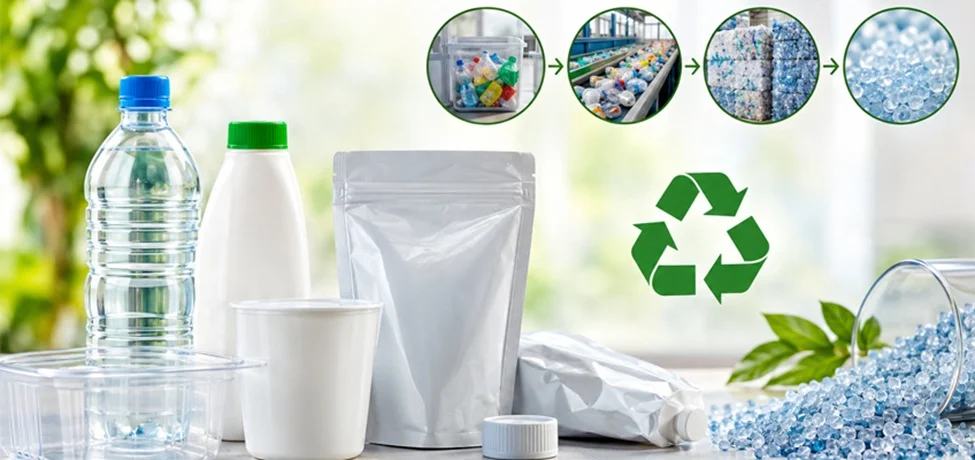
Quick answer: Design for recycling plastics means choosing materials, colors, labels, inks, closures and structures that sorting and recycling systems can handle, so the package is actually recycled, not just labelled "recyclable." The core rules are to use a single polymer where possible, avoid contaminants, make components separable, and match the design to local collection and sorting infrastructure. Regulations like Extended Producer Responsibility (EPR) and the EU's PPWR now reward good design with lower fees and penalize poor design with higher costs or market bans.
Why "recyclable" on the label isn't enough anymore
- Here's an uncomfortable truth many packaging teams have learned: a pouch can be technically recyclable in a lab and still end up in a landfill, because no sorting line can identify it and no recycler wants it.
- That gap between recyclable in theory and recycled in practice is the heart of plastic packaging recyclability. A package is genuinely recyclable only when it is collected, sorted, and reprocessed into new material at meaningful scale.
This is why designing plastics for recycling has moved from a sustainability "nice to have" to a business requirement. Brands face regulation, retailer scorecards and consumer scrutiny all at once. The good news is that most of the fixes are design decisions you control.
What is design for recycling in plastic packaging?
Design for recycling plastic packaging is the practice of building recyclability into a package at the concept stage rather than hoping the waste system will cope later.
It covers five decisions:
1. Material choice: which polymer, and how many.
2. Structure: monolayer, multilayer, or laminate.
3. Components: caps, labels, liners, sleeves, adhesives.
4. Appearance: colors, pigments, inks, metallization.
5. Format: size, shape, and whether sorting equipment can "see" it.
Get these five right and recyclers can turn your package into usable resin. Get them wrong and one component can contaminate an entire bale.
How to design plastic packaging for recycling: 7 practical rules
If you're asking how to design plastic packaging for recycling, start here.
1. Pick the right polymer first
Polymer selection for recyclable packaging is the biggest lever you have. Not all plastics have the same recycling infrastructure.
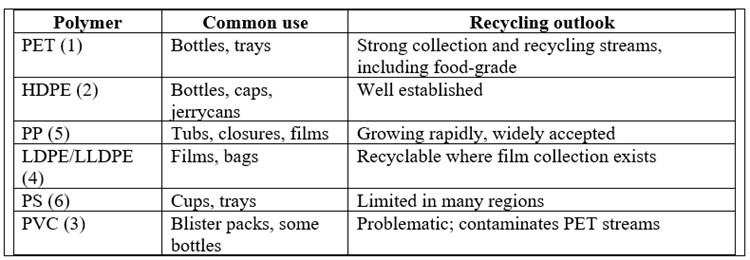
Fewer polymer types per package is almost always better. Whenever you can, choose PET, HDPE or PP, the materials with the deepest recycling markets.
2. Go mono-material wherever performance allows
Mono material packaging recycling works because recyclers deal with one polymer family instead of trying to separate bonded layers. A PE bottle with a PE cap and PE label is far easier to process than a PET bottle with a PVC sleeve and a PP closure.
Mono-material doesn't mean "no barrier." Modern high-barrier PE and PP films, and coatings that stay within the polymer family, are closing the gap with traditional multilayer structures.
3. Rethink flexible packaging
Flexible packaging design for recycling is the toughest challenge in the industry. Pouches and wrappers often combine PET, aluminum foil, nylon and PE to protect food, which makes them nearly impossible to separate.
What's working:
- All-PE or all-PP laminates that replace PET/PE or foil/PE structures
- Machine-direction oriented (MDO) PE films that add stiffness without a second polymer
- Thinner barrier layers such as EVOH kept below the level that disrupts recycling (check your regional guidelines)
- Right-sizing, meaning less film overall, which also helps your EPR fees
- Be honest about collection, too. Film recycling only works where store drop-off or kerbside collection for flexibles exists.
4. Design closures, labels and sleeves as part of the system
Small parts cause big problems. Check these:
- Caps and closures: use the same polymer family as the body, or one that floats while the body sinks (HDPE/PP caps on PET bottles are accepted because they separate in float-sink tanks).
- Labels: choose labels that are removable or that float away in wash conditions. Avoid full PVC sleeves on PET.
- Adhesives: use wash-off adhesives so labels release in hot caustic wash.
- Liners and seals: avoid aluminum or non-compatible liners where you can.
5. Watch color, carbon black and inks
Sorting systems use near-infrared (NIR) scanners. Carbon-black pigments absorb NIR light, so the package can be invisible to the sorter and be discarded as residue. Use NIR-detectable black alternatives, and favor clear or light-tinted bottles, since clear PET carries the highest recycled value.
Keep inks minimal and compatible with the wash process, and prefer direct printing in limited areas over full-body coverage.
6. Make it sortable and the right size
Very small items (generally under about 5 cm) fall through sorting screens. Bundling tiny parts into a larger recyclable unit, or attaching them to a larger body, keeps them in the stream.
7. Test with real recyclers
Use recognized guidance such as the Association of Plastic Recyclers (APR) Design Guide, RecyClass in Europe, or Plastics Recyclers Europe guidelines, and run your design through their protocols before launch. This single step prevents expensive redesigns later.
What is EPR packaging design and why does it matter?
Extended Producer Responsibility (EPR) makes brands and producers financially responsible for the packaging they put on the market, including its collection and recycling.
The key link to design is fee modulation. Under many schemes, the fee you pay depends on how recyclable your packaging is. This is where EPR packaging design becomes a direct profit-and-loss issue:
- Easy-to-recycle packaging, such as clear PET bottles, pays lower fees.
- Hard-to-recycle packaging, such as multilayer pouches and black trays, pays higher fees.
- Some schemes add recycled-content incentives or bonuses.
So EPR packaging recyclability isn't just a compliance topic. A redesign that moves you into a better fee category can pay for itself within a few production cycles.
EPR is spreading globally. The EU, UK, several US states (including Oregon, Colorado and California), and India all now have packaging EPR frameworks. India's Plastic Waste Management Rules, as amended in 2022, set EPR obligations by plastic category, including rigid, flexible, multilayer and compostable plastics, with targets for recycling and recycled content. If you sell in multiple markets, designing once to the strictest standard saves rework.
PPWR design for recycling: what the EU rules mean for you
The EU's Packaging and Packaging Waste Regulation (PPWR) is the biggest shift yet. In plain terms, PPWR design for recycling requirements say that packaging must be designed to be recyclable and actually recycled at scale, assessed on a performance grade from A to C, with the lowest-performing packaging eventually losing market access.
Key points to know:
- Recyclability criteria will be set through secondary legislation, based on design-for-recycling rules for each packaging material.
- Performance grades (A, B, C) will determine whether packaging can stay on the market; packaging that falls below the minimum threshold will eventually be prohibited.
- Recycled content targets apply to plastic packaging, with different percentages for contact-sensitive and other formats.
- EPR fee modulation will tie fees to recyclability grades.
- Harmonized labeling will help consumers sort correctly.
Dates and technical details are still being finalized through implementing and delegated acts, so check the official EU sources before locking in your roadmap. Even if you don't sell in Europe, PPWR is likely to set the benchmark other regions follow.
Material innovation: what's genuinely changing
A few developments are worth tracking:
- High-barrier mono-PE and mono-PP films that rival multilayer performance
- Chemical recycling for hard-to-recycle streams, still an emerging complement rather than a replacement for mechanical recycling
- Improved sorting tech such as AI-enabled optical sorting and digital watermarks (like HolyGrail 2.0) that embed invisible codes for precise identification
- Recycled-content resins with better quality and food-contact approvals
- Redesign to reduce, meaning eliminating unnecessary layers, sleeves and components altogether
The best innovation is often the simplest: remove the thing that doesn't need to exist.
A simple checklist before you launch
- Is the main polymer PET, HDPE or PP?
- Is the package mono-material, or are layers compatible?
- Are the cap, label and adhesive compatible with the recycling stream?
- Is the pigment NIR-detectable?
- Does infrastructure exist where the product is sold?
- Has it been assessed against APR, RecyClass or equivalent protocols?
- Does it meet local EPR and PPWR requirements?
Frequently asked questions
What is the best plastic for recycling?
PET and HDPE have the most established recycling systems worldwide, with PP gaining ground quickly.
Is mono-material packaging always recyclable?
No. It's easier to recycle, but recyclability also depends on additives, inks, labels, and whether collection and sorting infrastructure exists locally.
Why are multilayer pouches hard to recycle?
Their layers are bonded from different materials that can't be separated economically, so recyclers can't produce clean resin from them.
How does EPR improve packaging design?
Through fee modulation. Recyclable designs cost less, which gives brands a direct financial reason to redesign.
Does PPWR apply outside the EU?
Technically it applies to packaging placed on the EU market, but global brands often adopt its standards everywhere to simplify their portfolios.
Final thoughts
Designing plastics for recycling isn't about perfection. It's about making smart, informed choices early: fewer materials, compatible components, detectable colors, and designs tested against real recycling systems. Do that, and you cut compliance risk, lower EPR costs and make a product that genuinely closes the loop.
Start with one SKU. Run the checklist, fix the biggest problem, and measure the result. Small, steady redesigns add up faster than a big sustainability pledge that never ships.
 Media Pack Download
 Newsletters
 Industrial Events