Energy-Efficient Extrusion and Molding Systems: Reducing Costs While Achieving Sustainability Goals
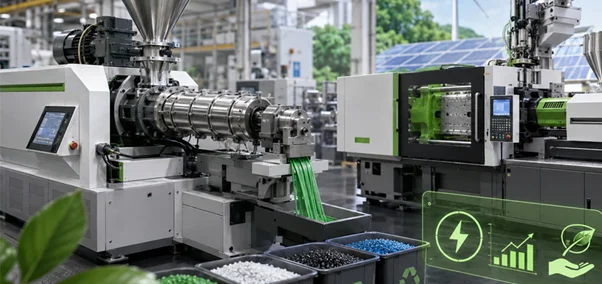
Electricity used to be a line item plant managers barely looked at. Not anymore. Between rising utility rates, tightening emissions regulations, and customers who now ask hard questions about where their packaging comes from, manufacturers are under real pressure to rethink how their machines consume power. That pressure has turned energy-efficient extrusion and energy-efficient molding from a "nice to have" into one of the most talked-about upgrades in industrial manufacturing.
The good news is that this shift isn't just about compliance or optics. It's genuinely good business. Plants that have moved to smarter, leaner plastic extrusion machines and molding equipment are seeing measurable drops in operating costs, often within the first year. Let's look at why this transition is happening now, how the technology actually works, and what it means for a manufacturer trying to balance profitability with sustainability.
| Also Read: Energy-Efficient Extrusion and Molding Systems: Reducing Costs While Achieving Sustainability Goals |
Why Energy Efficiency Became a Manufacturing Priority
Traditional extrusion equipment was built for a different era — one where electricity was cheap and continuous-run motors made sense because nobody was counting kilowatt-hours too closely. That era is over. Older hydraulic systems keep running at full power even during idle cycles, wasting enormous amounts of energy just to maintain pressure that isn't being used productively.
Three forces are pushing the industry toward energy saving plastic processing:
- Cost pressure. Energy can account for a significant share of total production cost in plastics manufacturing, particularly in extrusion-heavy operations. Cutting that number directly protects margins.
- Regulatory tightening. Many regions now require energy audits, emissions reporting, or efficiency certifications for industrial equipment, especially in the EU and parts of Asia.
- Customer expectations. Brands sourcing plastic components increasingly ask suppliers about their carbon footprint before signing contracts.
Put together, these forces have made low energy manufacturing less of an idealistic goal and more of a competitive necessity.
| Also Read: Industry 4.0 in Plastics Processing: Connecting Auxiliary Equipment through IoT and Predictive Maintenance |
What Makes an Extrusion System "Energy-Efficient"?
Not every upgrade labeled "efficient" actually delivers savings. It helps to understand what's structurally different about modern high-efficiency extruders compared to legacy machines.
Servo-Driven Drives Instead of Constant-Speed Motors
Older extruders often run motors at a fixed speed regardless of actual load. Modern systems use variable frequency drives (VFDs) or full servo motors that adjust power output in real time based on what the process actually needs. This alone can cut energy consumption meaningfully during partial-load and idle periods.
Barrel and Screw Design Improvements
Heat management inside the barrel matters more than most people realize. Better insulation, optimized screw geometry, and improved heater zoning mean the machine reaches and maintains processing temperature with less wasted thermal energy — a core part of genuine extrusion process optimization.
Regenerative Braking and Load Recovery
Some newer systems recover energy during deceleration phases and feed it back into the system rather than dissipating it as heat, similar to regenerative braking in electric vehicles.
Smart Idle and Standby Modes
Machines that automatically power down non-essential components during pauses avoid the classic problem of equipment running "hot" all day even when there's no material moving through it.
Servo-Driven Molding: The Injection Side of the Equation
While extrusion gets a lot of attention, injection molding is just as energy-hungry — arguably more so, because of the hydraulic clamping forces involved. This is where servo-driven molding machines have made the biggest difference.
Conventional hydraulic molding machines run pumps continuously, generating pressure whether or not the mold is actively cycling. Servo-driven systems replace that constant hydraulic flow with motors that only draw power when motion or pressure is actually required. The practical result: significantly reduced idle energy draw, quieter operation, and more precise control over injection speed and pressure — which also tends to improve part quality and reduce scrap rates.
This dual benefit — lower energy use and better consistency — is a big reason why servo-driven molding has moved from a premium option to something close to an industry standard for new equipment purchases.
The Role of Monitoring: You Can't Manage What You Don't Measure
Buying efficient hardware is only half the equation. The other half is visibility. This is where energy monitoring systems and broader industrial energy management platforms come in.
Modern plants are increasingly wiring their extrusion and molding lines into centralized dashboards that track:
- Real-time power draw per machine
- Energy cost per kilogram of processed material
- Idle-time energy waste
- Anomalies that suggest a motor, heater, or pump is degrading
This data does two things. First, it identifies which machines or shifts are the biggest energy drains, so upgrades can be prioritized where they'll actually pay off. Second, it creates a paper trail for sustainability reporting — increasingly important as more customers and regulators ask for verified emissions data rather than vague claims.
Combined with predictive maintenance alerts, energy monitoring turns what used to be a once-a-year audit into an ongoing, self-correcting process.
Smart Extrusion Technology: Where the Industry Is Heading
The next wave goes beyond individual machine efficiency and into full-line intelligence. Smart extrusion technology integrates sensors, AI-based process control, and adaptive algorithms that adjust extrusion parameters on the fly based on material behavior, ambient conditions, and throughput targets.
Instead of a technician manually tuning temperature zones and screw speed based on experience, the system continuously optimizes itself, shaving off energy waste that even skilled operators would miss. Some of these systems can also predict when a die or screw is wearing down in a way that's quietly increasing energy consumption — catching the problem before it shows up as a bigger bill or a quality issue.
This is really the convergence point of three trends: automation, sustainability, and cost control. They're no longer separate initiatives; they're the same initiative viewed from different angles.
Sustainability without Sacrificing Output
A common concern among plant managers is whether sustainable plastic processing means slower production or compromised part quality. In practice, the opposite tends to be true. Efficient machines generally run with tighter process control, which reduces:
- Material waste from inconsistent shots or extrusion drift
- Scrap rates from thermal instability
- Downtime from motor and pump wear caused by constant full-load operation
Fewer rejected parts and less unplanned downtime both translate into more usable output per hour of machine time — even before counting the direct energy savings.
Choosing Green Manufacturing Equipment: What to Actually Look For
For manufacturers evaluating new green manufacturing equipment, a few practical criteria matter more than marketing language:
- Verified efficiency ratings — look for third-party validated energy consumption figures, not just manufacturer claims.
- Compatibility with monitoring systems — the machine should be able to feed data into your existing or planned energy management platform.
- Modular upgrade paths — servo retrofits or drive upgrades on existing machines can sometimes deliver much of the benefit without a full capital replacement.
- Total cost of ownership, not just purchase price — a machine with a higher upfront cost but 20–30% lower energy draw often pays for the difference within two to three years, depending on utilization.
Moving Toward Carbon-Efficient Plastic Production
Ultimately, all of this rolls up into a bigger goal: carbon-efficient plastic production across the entire manufacturing footprint, not just at the machine level. That means considering energy sourcing (on-site solar or renewable power contracts), waste heat recovery from extrusion barrels, and material efficiency alongside pure electrical consumption.
Plastics manufacturing will likely never be a low-energy industry in absolute terms — the physics of melting and shaping polymer requires real power. But the gap between an inefficient plant and a well-optimized one is enormous, often 20–40% in comparable operations. Closing that gap is where the real opportunity sits, both for cost savings and for genuinely meeting sustainability commitments rather than just reporting on them.
Frequently Asked Questions
What is energy-efficient extrusion?
Energy-efficient extrusion refers to plastic extrusion processes that use optimized machine components — such as servo drives, improved barrel insulation, and smart process controls — to reduce electricity consumption without sacrificing output quality or speed.
How much energy can servo-driven molding machines save compared to hydraulic systems?
Servo-driven molding machines typically reduce energy consumption significantly compared to conventional hydraulic systems, mainly because they only draw power during active motion rather than running pumps continuously.
Are energy-efficient extruders more expensive to buy?
Generally, yes — upfront costs tend to be higher. However, the reduced energy draw usually offsets that difference within a few years, especially in facilities running multiple shifts.
What role do energy monitoring systems play in plastic manufacturing?
Energy monitoring systems track real-time power usage, identify inefficient machines or processes, and support sustainability reporting, allowing manufacturers to make data-driven decisions about upgrades and maintenance.
Can existing extrusion equipment be retrofitted for better efficiency?
In many cases, yes. Drive upgrades, improved insulation, and the addition of monitoring sensors can improve efficiency on existing machines without requiring a full replacement.
Is sustainable plastic processing compatible with high-volume production?
Yes. Efficient machines often improve process consistency, which reduces scrap and downtime — meaning sustainability gains and production volume are not mutually exclusive.
 Media Pack Download
 Newsletters
 Industrial Events