
Granulators and Recycling Systems in Plastic Manufacturing
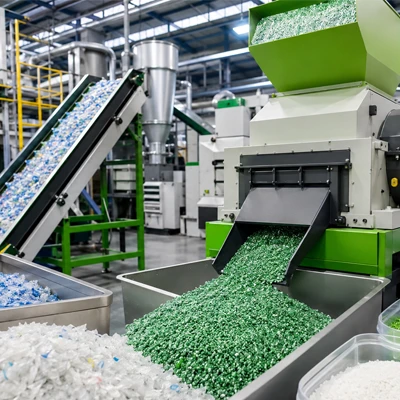
Production scrap was once considered a problem for plastic manufacturing, but it isn't today. Today, every kg of plastic is worth something and manufacturers are finding more and more means to recover, re-use and get the value back into their business. Increasingly, production plants are interested in recycling technologies due to the rising costs of raw materials, sustainability commitments, and environmental regulations.
Plastic Granulators and integrated Plastic Recycling Systems are among the most significant technologies contributing to this transformation. These solutions enable manufacturers to process their production scrap, minimise material loss and run them more efficiently without compromising the quality of their products.
Injection molding companies which produce automotive components to packaging companies which are creating flexible films, recycling has become a part of the present Plastics Processing. No longer only to do with the management of waste, they are now regarded as instruments to enhance profitability and sustainability.
Why recycling plastics is important within manufacturing facilities
All plastics processing activities have some degree of scrap production. Common examples include start-up runs, defective parts, edge trims, runners, sprues and products off-specification. Even highly optimized facilities produce waste during normal operations.
Most of this material used to be scrapped or sold to third party recyclers. That method is still in use in a few instances, but most manufacturers now realize that production scrap is a source of valuable material that can often be reused within the establishment.
This is where Plastic Waste Recycling Equipment can be of critical importance. Rather than a waste management issue, manufacturers can recapture and reprocess the material for future runs. This translates to lower material costs, less waste and more efficient use of existing resources in the plant.
The economic benefits are sometimes a lot more pronounced, particularly in resin-intensive sectors like the electronics sector.
Understanding Plastic Granulators
The Plastic Granulators form the core of the majority of recycling firms. The machines are intended to break the plastic waste into smaller, uniform pieces called regrind.
A granulator can be considered as a link between waste scrap and reusables. Large plastics that would be hard to process are broken down into smaller plastics that are easier to handle and can be incorporated into virgin resin or recycled in a desirable application.
Modern Granulators for Plastic Manufacturing can process all kinds of materials such as:
- Injection molded parts
- Blow-molded containers
- Plastic sheets
- Pipes and profiles
- Film scrap
- Packaging waste
- Engineering plastics
The objective is straightforward: transform production waste into material that can return to the manufacturing process.
How the Granulation Process Works
The designs vary slightly from manufacturer to manufacturer, but idea remains the same.
The plastic waste is fed into a cutting chamber where rotating blades and stationary knives cut the material. This is because as they pass through the chamber, they are gradually broken down into smaller pieces.
When the desired size is achieved the material goes through a screening apparatus and is gathered for further processing.
The process seems straightforward, but there is a certain engineering involved to ensure a uniform particle size. Factors such as rotor speed, knife configuration, material type, and screen size all influence final output quality.
As granulators are type of Size reduction machinery, their operation directly affects the processing efficiency of the following recycling processes.
The size of the material can lead to feeding problems, bad product quality and reduced process efficiency. That is why it is important to choose the right granulator in a recycling project.
Some of the various granulators used in manufacturing are as follows:
Not all production environments have the same recycling requirements.
A small injection molding facility producing consumer goods may have very different needs compared to a large automotive parts manufacturer.
Beside-the-Press Granulators
These small machines are located beside molding machines and process scrap is introduced right after it is produced.
This is a convenient way for many manufacturers as it offers them the opportunity to recycle plastic efficiently in-house with minimal material handling.
Operators can quickly recover runners, sprues, and rejected parts without transporting material across the facility.
Central Granulators
Larger facilities often use centralized recycling systems. The various production lines generate waste which can be gathered and delivered to a specific recycling zone where there are larger granulators working.
This is often used in high-volume manufacturing systems.
Heavy-Duty Granulators
Other applications include thick-walled products or large plastic parts where more cutting power is needed.
Heavy-duty granulators are specially made for such applications and can handle large amounts of material without any problems.
The Role of Plastic Shredding Equipment
Not all the plastic products can be fed directly in the granulator.
Large pallets, drums and other industrial containers, along with large molded pieces require preliminary size reduction. Here, Plastic shredding equipment can prove useful.
Shredders perform the first stage of processing by breaking large items into smaller pieces. Then the material can be shredded again in granulators for further reduction.
Many modern recycling operations have the shredders and granulators working in tandem. This configuration provides increased throughput, yet decreases wear on cutting parts.
The shredding and granulation process can be most useful for manufacturers with high volumes of industrial scrap.
Looking Beyond Granulators: Complete Plastic Recycling Systems
A granulator alone does not constitute a recycling operation. Effective material recovery usually requires a broader approach involving integrated Plastic Recycling Systems.
These systems may include:
- Conveyors
- Shredders
- Granulators
- Metal separation units
- Dust collection systems
- Dryers
- Storage hoppers
- Blending equipment
- Automated feeding systems
These technologies combine to form a seamless cycle, from scrap production to reuse, with minimal human involvement.
The level of automation depends on the production requirement but the aim is always the same, to maximize material recovery and be efficient.
Regrind Processing Systems and Material Recovery
Once material has been granulated, it often enters Regrind processing systems before being reused.
This stage is particularly important because recycled material must meet quality requirements suitable for manufacturing applications.
Depending on the material and product specifications, regrind processing may involve:
- Removing contaminants
- Screening particles
- Drying moisture-sensitive materials
- Blending recycled and virgin resin
- Transporting material to production equipment
Manufacturers are diligent in controlling these processes to ensure that recycled content does not adversely impact products.
Improvements in regrind processing equipment have enabled increased amounts of recycled material to be used while maintaining quality.
The increasing popularity of in house plastic recycling
As for the plastic recycling industry, there is a clear trend of more and more companies turning to In-house plastic recycling. This is being driven by a number of factors.
For one thing, manufacturers have more control on quality of materials. They can track each step of the recycling process, rather than relying on outside recycling companies to handle it.
Second, internal recycling can also decrease the transportation costs and handling costs.
Third, material can be returned to production much faster.
In some facilities, scrap generated during a morning shift may be processed and reused later the same day. That level of efficiency would be difficult to achieve using external recycling services.
For companies facing rising resin prices, the financial benefits can be substantial.
Industrial Plastic Recycling Solutions Are Becoming Smarter
Industrial plastic recycling solutions are quite different 10 years ago.
As the equipment manufacturers adopt technologies such as automation, digital monitoring, and smart controls, they are finding it beneficial to their systems.
Modern recycling lines can track:
- Material throughput
- Energy consumption
- Equipment performance
- Maintenance requirements
- Production efficiency
This data can help operators to pinpoint bottlenecks, enhance productivity and minimise downtime.
Some systems can even generate predictive maintenance alerting, minimising unexpected equipment failure.
Recycling systems are developing in parallel with the manufacturing system that is turning to Industry 4.0 technologies.
Energy Efficiency Is Now a Key Consideration
Globally manufacturers have been growing more aware of the cost of energy.
Consequently, the energy-efficient granulators for industrial recycling are still in demand.
Older machines used a significant amount of power, especially in heavy duty processing applications. The newer ones are aimed at minimizing energy usage without compromising productivity.
This is being accomplished by manufacturers through:
- High-efficiency motors
- Optimized rotor designs
- Improved cutting geometries
- Variable-speed drives
- Intelligent load control systems
Reduced energy use leads to not only cost savings in operation, but also contributes to overall sustainability efforts.
Organizations that are aiming at environmental goals can reap both financial and environmental rewards by investing in energy-efficient equipment.
The Circular Economy in plastics – a challenge!
The concept of a Circular economy in plastics has gained significant attention across the manufacturing sector.
The circular economy is different from the linear produce, use and discard approach because it encourages long-lasting material use, by recovery and recycling.
Granulators and recycling systems are an important part of the vision to do this.
The more times the scrap is recovered and used in the manufacturing process, the less virgin material is needed. The amount of waste is minimised, resources are utilized and environmental impacts are reduced.
Recycling by itself can help meet all of the sustainability problems in the plastics industry, but it is one of the most available and convenient answers to the problems that are immediate.
For many manufacturers, recycling equipment is no longer just a running expense, it's an important aspect of their sustainability plan.
Future Outlook
It's likely that plastic manufacturing will become even more integrated with recycling technologies in the future.
Process automation, artificial intelligence, smart sorting systems and better process controls are already shaping equipment designs. Manufacturers are seeking solutions to save material and to make it easier.
Meanwhile, the sustainability concerns of consumers, regulators and investors are on the rise.
The mixture of economic and environmental pressures is anticipated to drive industry to increasingly adopt advanced recycling technologies.
Companies investing in cutting-edge recycling equipment now will be more ready to meet evolving market demands in the future.
Conclusion
The plastics sector is striving to be more efficient and environmentally friendly, and Plastic Granulators and integrated Plastic Recycling Systems are invaluable tools on the manufacturing floor.
These technologies can assist companies in recovering valuable materials that they may be losing, from reducing production scrap to allowing for the effective In-house plastic recycling.
Manufacturers have greater choices than ever in order to utilize their resources better, whether they're using Plastic shredding equipment, advanced Regrind processing systems, or a complete Industrial Plastic Recycling Solutions.
Combined with the growing adoption of energy-efficient plastic granulators for industrial recycling, these systems are helping businesses reduce costs while supporting the principles of a Circular economy in plastics.
For manufacturers seeking practical ways to balance productivity, profitability, and sustainability, recycling technologies are no longer optional additions—they are increasingly becoming a core part of modern plastic manufacturing operations.
 Media Pack Download
 Newsletters
 Industrial Events