High-Precision Plastic Injection Molding for EVs, Medical Devices and Consumer Electronics
What Is Precision Injection Molding?
Precision injection molding is a manufacturing process that produces plastic components to extremely tight tolerances - often within a few microns - using specialized tooling, controlled machine parameters, and rigorous quality inspection. Unlike standard injection molding, where a small dimensional variance might not matter, high precision plastic molding is built for industries where a 0.01mm error can mean a part doesn't fit, a device doesn't seal, or a connector doesn't make contact.
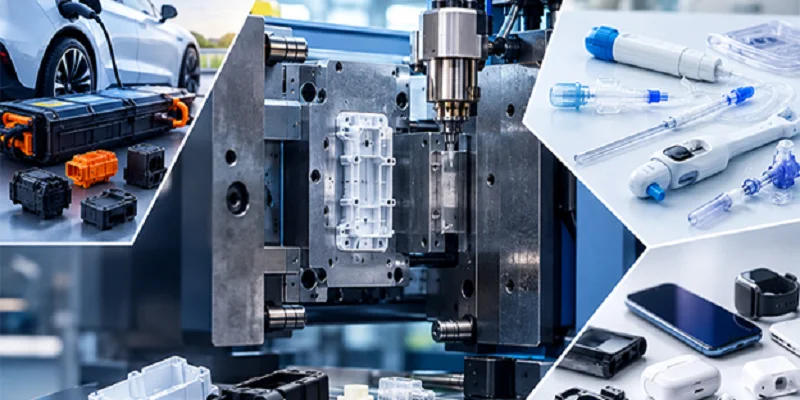
That's exactly why three industries - electric vehicles, medical devices, and consumer electronics - have become the biggest drivers of demand for precision plastic components today. Each of these sectors needs parts that are smaller, lighter, more durable, and more exact than what molding shops were producing even a decade ago.
If you're sourcing components for any of these industries, understanding how precision molding actually works - and what separates a good molder from a great one - can save you from expensive redesigns, failed audits, or field failures down the line.
Why Tight Tolerances Matter More Than Ever
Three forces are pushing manufacturers toward tighter tolerances:
- Miniaturization. Devices keep shrinking, but they still need to hold more components inside them. That means less room for error.
- Regulatory pressure. Medical and automotive parts are held to strict compliance standards (ISO 13485, IATF 16949) where documentation and repeatability matter as much as the part itself.
- Performance demands. EV battery housings, electronics enclosures, and surgical instruments all need to perform flawlessly under stress, heat, or repeated use.
This is where tight tolerance injection molding earns its keep. It's not just about making a part look right - it's about making sure ten thousand units in a row behave exactly the same way.
Precision Molding for EV Components
Electric vehicles have completely changed what automotive precision molding needs to deliver. Traditional combustion vehicles relied heavily on metal parts, but EVs are pushing manufacturers to replace metal with engineered plastics wherever it's safe to do so - mainly to cut weight and extend range.
EV plastic components now show up in places you might not expect:
- Battery pack housings and cell separators, which need flame-retardant, dimensionally stable materials that won't warp under thermal cycling
- Connector housings and busbars, where tight tolerances directly affect electrical contact and safety
- Sensor housings for ADAS (advanced driver-assistance systems), which require optical-grade clarity and micron-level accuracy
- Charging port components, exposed to repeated mechanical stress and weather
- Thermal management parts, like coolant manifolds and battery cooling plates
Precision molding for EV components isn't just about shrinking part weight. It's about designing plastics that can handle heat, vibration, and electrical loads that older automotive plastics were never asked to manage. A molder working in this space needs experience with high-performance engineering resins like PPS, PPA, and glass-filled nylons, plus the process control to hold tolerances across long production runs.
Medical Injection Molding: Where Precision Is Non-Negotiable
Few industries demand more from a molder than healthcare. Medical injection molding sits at the intersection of biocompatibility, sterility, regulatory compliance, and dimensional accuracy - and there's very little room for "close enough."
Medical grade plastic molding involves working with resins that are biocompatible, chemically resistant, and often required to survive repeated autoclave sterilization cycles without degrading. Materials like medical-grade polycarbonate, PEEK, and USP Class VI-approved polymers are common choices, and every resin lot typically needs full traceability.
Common medical device plastic components produced through this process include:
- Surgical instrument housings and handles
- Drug delivery device components, like inhaler bodies and auto-injector housings
- Diagnostic equipment casings
- IV connectors, valves, and fluid management components
- Implantable device components requiring extreme biocompatibility
Because many of these parts are literally going inside or onto the human body, even the smallest dimensional inconsistency can create a functional or safety issue. That's why medical molders typically operate cleanrooms rated to ISO Class 7 or 8, run under ISO 13485 quality systems, and validate every mold using IQ/OQ/PQ protocols (Installation, Operational, and Performance Qualification) before a single part ships to a customer.
Electronics Plastic Injection Molding and the Push Toward Micro Parts
Consumer electronics may be the most visible proving ground for precision molding, simply because so many of us handle these devices every day. Electronics plastic injection molding covers everything from smartphone housings and laptop chassis to the tiny internal brackets, connectors, and switches most users never see.
What makes this segment particularly demanding is the trend toward miniature plastic components. As devices get thinner and more densely packed, molders are increasingly turning to micro injection molding - a specialized process for producing parts that can weigh a fraction of a gram, sometimes smaller than a grain of rice, while still holding tolerances measured in microns.
Typical applications include:
- Connector pins and micro-housings for wearables
- Camera module components for smartphones
- Switch and button mechanisms
- Fiber optic connector components
- Hearing aid and earbud housings
Micro injection molding requires purpose-built machines with high-precision injection units, specialized micro-tooling, and often optical measurement systems just to verify that parts meet spec - standard calipers won't cut it at this scale.
What Actually Makes a Molding Process "High Precision"?
A lot of shops claim to offer high precision plastic molding, but the difference usually comes down to a handful of factors that aren't always visible on a spec sheet.
Precision injection mold design comes first. Tolerances are essentially locked in at the design stage - mold flow analysis, gate placement, cooling channel layout, and steel selection all determine whether a part can consistently hold spec once it's in production. A poorly designed mold can't be fixed with better machine settings later.
Process control matters just as much. High-performance injection molding relies on closed-loop systems that monitor and adjust injection pressure, melt temperature, and cooling rates in real time, rather than relying on operators to catch drift manually.
Material science expertise ties it together. Precision plastic components often use engineered resins - glass-filled, flame-retardant, or medical-grade - and each material behaves differently during molding. A shop with strong material knowledge can predict shrinkage, warpage, and tolerance stack-up before the first shot is even made.
In-process quality inspection rounds it out. Coordinate measuring machines (CMMs), vision systems, and statistical process control (SPC) let manufacturers catch tolerance drift before it turns into scrap - or worse, a shipped defect.
Choosing a Precision Molding Partner: A Quick Checklist
If you're evaluating suppliers for automotive, medical, or electronics programs, a few questions tend to separate serious precision molders from generalists:
- Do they have industry-specific certifications (IATF 16949 for automotive, ISO 13485 for medical)?
- Can they provide mold flow simulation and DFM (Design for Manufacturability) feedback before cutting steel?
- What's their documented tolerance capability - and can they prove it with real Cpk data?
- Do they have in-house tooling, or do they outsource mold builds?
- Can they scale from prototype runs to high-volume production without re-validating the entire process?
- What inspection equipment do they run in-house - CMM, vision systems, or manual gauging only?
A supplier that can answer these clearly, with data rather than marketing language, is usually the one worth trusting with a critical part.
Frequently Asked Questions
What tolerance is considered "high precision" in injection molding?
Most high precision plastic molding falls in the range of +/- 0.005mm to +/- 0.02mm, though micro injection molding for medical or electronics components can require even tighter control depending on part geometry and material.
What materials are used for medical-grade plastic molding?
Common choices include medical-grade polycarbonate, PEEK, ABS, polypropylene, and USP Class VI-compliant resins, selected based on sterilization method, biocompatibility requirements, and mechanical demands.
Why are EVs increasing demand for precision plastic components?
EV manufacturers are replacing metal parts with engineered plastics to reduce vehicle weight and extend battery range, while still needing components that handle heat, vibration, and electrical loads reliably.
What's the difference between standard and micro injection molding?
Micro injection molding produces parts typically under a gram in weight, using specialized machinery and tooling capable of holding micron-level tolerances that standard molding equipment can't achieve.
How do manufacturers verify tight tolerance injection molding results?
Through in-process inspection tools like coordinate measuring machines (CMMs), optical comparators, and statistical process control (SPC) data, which track dimensional consistency across full production runs - not just sample parts.
Final Thoughts
EVs, medical devices, and consumer electronics don't have much in common on the surface, but they're all converging on the same manufacturing requirement: precision plastic components that perform exactly the same way, part after part, under real-world stress. That consistency doesn't happen by accident - it's the result of smart mold design, tight process control, and a manufacturing partner who understands the specific demands of your industry.
Whether you're sourcing a battery housing, a surgical device component, or a micro connector for a wearable, the fundamentals stay the same: get the tolerances right, choose the right materials, and work with a molder who can prove their process, not just describe it.
 Media Pack Download
 Newsletters
 Industrial Events