High-Temperature Engineering Plastics: PEEK, PTFE and PPS Stock Shapes for Demanding Applications
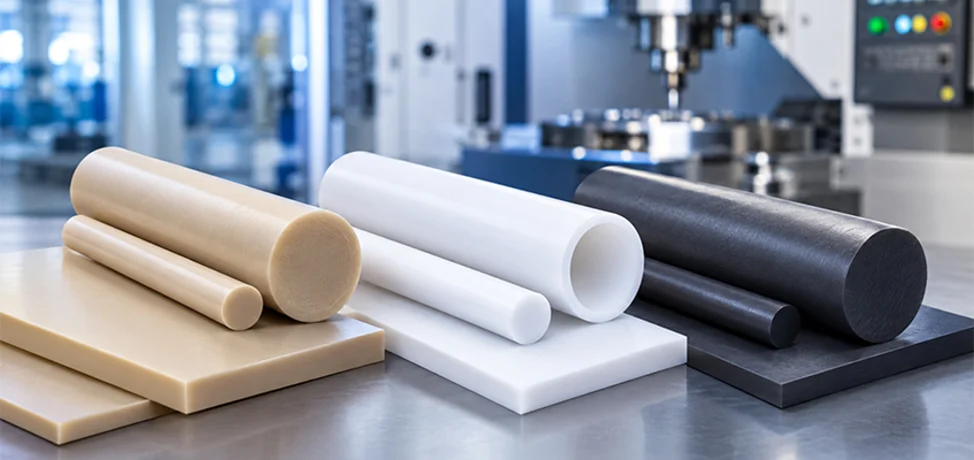
Quick answer: PEEK, PTFE and PPS are the three most widely used high temperature engineering plastics in machined parts. PEEK gives the best strength at heat (up to about 250°C continuous). PTFE gives unmatched chemical resistance and low friction (up to about 260°C). PPS gives stable, precise parts at a lower cost (up to about 200-220°C). All three come as engineering plastic stock shapes, mainly rods, sheets, plates and tubes, ready to machine.
Why metal isn’t always the answer
Ask a plant engineer what to use for a part that sits next to a hot, corrosive process, and many will still say stainless steel. Steel works, but it is heavy and expensive to machine. It corrodes in some chemicals and needs lubrication when it slides against other parts.
That’s where high temperature plastic materials earn their place. A well-chosen polymer can replace a metal part and cut weight. It can resist chemicals that attack steel, and it can often run without oil or grease.
You still need to pick the right plastic. PEEK, PTFE and PPS look similar on a data sheet, but they behave very differently in a real machine. Here’s how to tell them apart.
What are stock shapes, and why do buyers prefer them?
A stock shape is a semi-finished plastic form made for machining. PEEK rods and sheets, PTFE rods and sheets and PPS rods and sheets are the most common. Tubes, bushings, plates and custom profiles are also available.
Machinists like stock shapes for good reasons:
- No tooling cost. You skip the injection mold, which is a big saving for prototypes and low volumes.
- Fast turnaround. A CNC shop can turn a rod into a bushing the same week.
- Consistent quality. Extruded and compression-molded shapes are stress-relieved and have predictable properties.
- Easy changes. If the design changes, you update the program instead of the mold.
For repair parts, small batches and custom components, engineering plastic stock shapes are often the most practical choice.
PEEK stock shapes: the high-performance choice
PEEK (polyether ether ketone) is the one engineers reach for when the application is truly hard.
Key properties
- Continuous service temperature of about 250°C
- Melting point around 343°C
- High strength, stiffness and creep resistance, even when hot
- Good resistance to chemicals, steam and hydrolysis
- Excellent wear resistance, especially in bearing grades
- Low outgassing and flame retardant, with low smoke
Where it’s used: semiconductor wafer-handling parts, aerospace brackets, oil and gas seals and back-up rings, compressor valve plates, pump wear rings, medical and dental instruments (in approved grades), and electrical insulators.
What to know before buying
PEEK is expensive. A PEEK rod can cost many times more than nylon or acetal. It is worth the money when failure is costly, such as downtime on a critical machine or a part that can’t be replaced easily.
PEEK rods and sheets come in several grades:
- Unfilled (natural): the general-purpose option with the best chemical and mechanical balance.
- Glass-filled: stiffer, with less thermal expansion.
- Carbon-filled: higher strength, better wear and better thermal conductivity.
- Bearing grade: carbon, graphite and PTFE blends for sliding applications.
PTFE stock shapes: slippery, inert and tough against chemicals
PTFE (polytetrafluoroethylene) is best known by the brand name Teflon. It isn’t the strongest plastic, but it has two traits nobody else matches. It resists almost every chemical, and it has one of the lowest friction coefficients of any solid.
Key properties
- Continuous service temperature of about 260°C
- Excellent resistance to acids, bases and solvents
- Very low friction and a non-stick surface
- Very good electrical insulation, even at high frequencies
- Usable across a very wide temperature range, from cryogenic to hot
Where it’s used: chemical-processing seals and gaskets, valve seats, bearing pads, labyrinth seals, electrical insulators, food-contact parts and laboratory equipment.
The catch
PTFE is soft. It creeps (slowly deforms) under constant load, and it has low wear resistance in its pure form. This is why filled grades are so common. Glass fiber, carbon, graphite and bronze fillers improve strength and reduce creep.
When you buy PTFE rods and sheets, you’ll usually see virgin PTFE (the purest, for chemical and food use) alongside filled grades for harder mechanical duty. PTFE is also hard to bond, so plan for mechanical fastening or surface etching if you need to glue it.
PPS plastic stock shapes: the underrated workhorse
PPS (polyphenylene sulfide) is the one buyers overlook. It sits between standard engineering plastics and ultra-premium ones like PEEK.
Key properties
- Continuous service temperature of about 200-220°C
- Very good dimensional stability and low moisture absorption
- Excellent resistance to chemicals and hot water
- Naturally flame retardant
- Stiff, hard and good for tight tolerances
- Costs far less than PEEK
Where it’s used: pump components, valve parts, electrical connectors and housings, automotive fuel and cooling system parts, and precision fixtures and test sockets.
What to watch
PPS is stiff but can be brittle, especially in glass-filled grades. It isn’t the best choice for parts that take heavy impact. For stable, precise parts under heat and chemicals, though, PPS plastic stock shapes deliver strong performance at a sensible price.
PEEK, PTFE and PPS comparison
Here is a side-by-side PEEK PTFE PPS comparison to help you narrow down your options. Values are typical and vary by grade and supplier, so always check the data sheet.
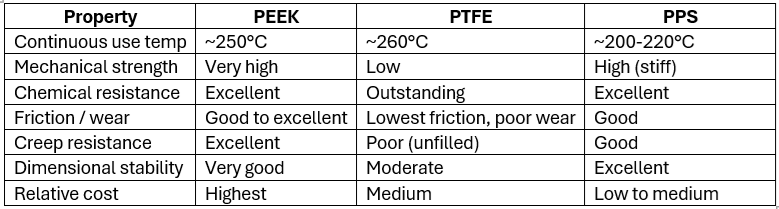
Simple thumb rule:
- Need strength and heat together? PEEK.
- Need chemical inertness or low friction? PTFE.
- Need stable, precise parts without paying for PEEK? PPS.
How to choose the right material
Material selection goes wrong when people start with the plastic instead of the problem. Start with these questions:
- What’s the real operating temperature? Include spikes, not just the average. Also check whether the part is loaded at that temperature, because plastics lose stiffness as they heat up.
- What chemicals will it touch? Check the exact chemical, concentration and temperature. Resistance at room temperature doesn’t guarantee resistance at 150°C.
- Will it carry load or slide? If so, creep and wear matter more than the headline temperature rating.
- Do you need tight tolerances? Dimensional stability and thermal expansion will matter.
- What’s the budget, and what does failure cost? A cheaper material that fails twice often costs more than PEEK once.
Don’t forget regulations. Food, medical, semiconductor and aerospace jobs may need specific certifications, so confirm them with your supplier before you order.
Machining tips that save money
These materials machine well, but some habits make a big difference:
- Use sharp tools and good chip clearance. Dull tools cause heat and poor surface finish.
- Anneal PEEK if tolerances are tight. This relieves machining stress and prevents warping later.
- Take light cuts on PTFE. It’s soft and moves under tool pressure, so clamp it gently.
- Cool glass-filled grades properly. They wear tools faster, so expect to change inserts more often.
- Allow for thermal expansion. A part that fits perfectly at room temperature may bind at 200°C.
Frequently asked questions
What is the highest-temperature engineering plastic among the three?
PTFE has a continuous rating of about 260°C, slightly above PEEK at about 250°C. PEEK is much stronger at those temperatures, so it is usually the better choice for load-bearing parts.
Is PEEK better than PTFE?
Neither is better in every case. PEEK is stronger and more wear resistant. PTFE has better chemical resistance and much lower friction. Choose by what the part has to do.
Why is PPS cheaper than PEEK?
PPS is simpler to produce and has a lower temperature ceiling. It suits many industrial jobs where PEEK’s extra performance isn’t needed.
Can these plastics replace metal?
Often, yes. Common examples are bushings, seals, wear rings, insulators and valve parts. Check load, temperature and expansion first, because plastics are not a drop-in replacement for steel in every case.
Are PEEK, PTFE and PPS food safe?
Natural PTFE and some PEEK grades are available in food-contact compliant versions. Always ask for the certification for the specific grade, since colored or filled grades may not qualify.
What forms are available?
High temperature plastic rods and sheets are the most common. Tubes, plates, bushings and machined blanks are also widely sold.
Final thoughts
The right engineering plastic for industrial applications comes down to matching the material to the job, not buying the most expensive grade. PEEK handles heat and load together. PTFE handles chemicals and friction. PPS gives stable, precise parts at a lower price.
If you’re unsure, send your supplier the operating temperature, the chemicals involved, the load and the tolerances. A good stock-shape supplier can usually recommend a grade within a day, and that conversation costs far less than a failed part.
 Media Pack Download
 Newsletters
 Industrial Events