Innovations in Gas-Assisted Injection Molding for Complex Parts
The world of manufacturing is ever changing with technological advances breaking new grounds of precision, complexity, and efficiency. Of these breakthroughs, the gas-assisted injection molding technique is a technique that is revolutionizing the manner in which the production of complex plastic parts in the various industrial processes is being pursued. Lightweight components to strong structure designs, gas integrated injection molding has enabled new area by its entrance into process when before without gas considered impossible using the old methods.
However, what is so attractive about gas-assisted injection molding? What are the key methods of manufacturers who foster seamless geometry, cost-saving, and speed of production whilst aiming at the outstanding quality of plastic part designing?
So, science, the strategy and the future of plastic injection creations that are moving the world of complex molding in the automotive and beyond, so, let us take a closer look.
Understanding the Foundation: What is Gas-Assisted Injection Molding?
Understanding the drawbacks of the conventional injection molding technique is essential to comprehending the development of gas-assisted injection molding. The pieces are traditionally made by injecting molten plastic into a mold. This approach may form sink marks, distort or fail to fill thick/large sections, however. That is where gas comes in.
The principle of gas-assisted molding is very smart. After pouring melted plastic into the mold cavity, high pressure inert gas - usually nitrogen - is added. The plastic is forced out to the mold's edges by this gas, leaving the center hollow and dispersing it throughout all of the nooks and crannies. The result? Strength, light weight, less material use, short post metal cooling time, and smaller defects.
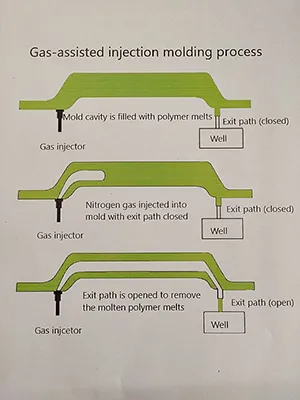
The injection of gas at specific points in the molding cycle allows the manufacturer to produce superior control over the actual thickness of the walls, minimize weld lines, as well as internal stresses - vital when producing some complicated parts of plastic.
Reimagining Plastic Part Design
The design consequences are tremendous in the field of plastic parts. Designers are not limited anymore by the complexity of parts or thickness. It is now possible that hollow sections can be made without secondary process of coring or drilling. It is a game changer to industries that require ergonomic, lightweight and mechanically strong parts.
As another example, thin sections allowing ribs and supports to be concealed can be used in the furniture or electronics industries, and made by gas-assisted (or passive) injection molding. In automotive complex molding, at the same time, the dashboards, handles, and bulky parts and supports are reduced in weight and would have the same strength throughout the part.
With the development of new and improved molding techniques, design teams are allowed to go to the extremes. Structurally solid parts that are thick? Achievable. Surfaces that are beautiful, unblemished, and not warped? Expected. The combination of gas technology and the mold engineering industry has made available things that the traditional plastic injection innovations could never even cover.
The Science behind Efficiency: Efficient Molding Systems
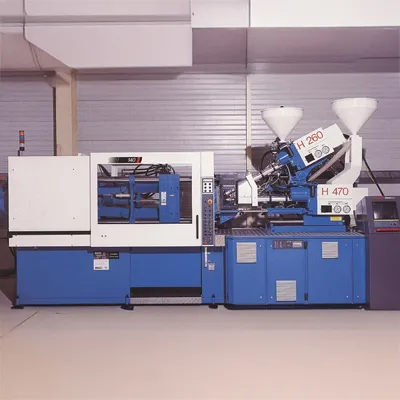
The development of effective molding equipment is intimately related to the introduction of gas-assisted injection molding. But what does this mean by an efficient system?
The ability to have increased efficiency is made up of minimized material wastage, cycle time reduction, and energy saving. Less resin is needed because gas displaces some of the plastic in the mold. This does not only save on materials but also on the duration of time the plastic is already supposed to have cooled and solidified. Additionally, the gas pressure produces dimensional stability, which eliminates costly errors or repairs.
Such time and materials savings hold the prospect of bottom line profits in larger and mass production environments and particularly the automotive, appliance and consumer goods industries. Effective molding systems are able to pump thousands of flawless complex pieces of plastics and provide repeatability and precision with a single product range.
No wonder, therefore, that companies which aspire sustainable practices and lean manufacturing are spending many dollars in such advanced molding techniques.
Table: Traditional Injection Molding vs. Gas-Assisted Injection Molding
| Feature | Traditional Injection Molding | Gas-Assisted Injection Molding |
| Wall Thickness Limitations | High risk of sink marks | Uniform wall thickness with reduced warping |
| Cooling Time | Longer due to full material fill | Shorter as gas displaces plastic |
| Design Flexibility | Restricted for intricate geometries | Perfect for items that are hollow and complicated |
| Material Usage | Higher | Reduced by up to 30% |
| Production Cost | Higher due to rework, scrap | Lower due to fewer defects |
| Surface Finish | Potential imperfections | Enhanced aesthetics with fewer blemishes |
| Structural Integrity | Varies | Hollowed yet strong designs |
Such a comparison shows that gas-assisted injection molding is manifestly profitable in respect to flexibility, cost, and efficiency, which are the three foundations of the modern-day production.
The Role of Plastic Injection Innovations in Market Evolution
The demand of lightweight, durable plastic components is raising in the world, and with that the pressure on the manufacturers who have to provide more intelligent, cost-efficient solutions. It is because of this that injection plastic technologies like their gas-assistance have played out to be not an option anymore, but a necessity.
Efficient molding systems that dynamically incorporate AI and real-time monitoring are now used by companies to achieve consistency and better optimization of the gas flow parameters. Smart sensors are the answer to monitoring pressure, temperature, and the flow, so that gas assisted injection molding will always give best possible results on collection each cycle.
Further there are hybrid systems becoming standard gas-assisted injection molding combined with other high-tech molding processes such as multi-shot molding, insert molding and in-mold decoration. These incorporations aid to create multifunctional, attractive, and structurally rigid components without extra assembly or surface treatment.
Exploring Complex Molding for Automotive Applications
Of all the industries, automotive complex molding is leading on innovation adoption. Car manufacturers are constantly challenged to make vehicles considerably lighter to be fuel-efficient but, at the same time, secure and powerful. This has caused an upsurge in the use of engineered plastics and gas assisted injection molding.
Consider such complex components as A/B/C pillars, handles on the doors, glove boxes, and under-the-hood parts. These components require perfection in strength, beauty, and precision of dimensions which can be done by using the gas-assisted injection molding process.
Besides, the design of plastic parts in auto machinery has evolved with slim, intelligent and incorporated plastic parts. Electronics, sensors, and entertainment systems can now be housed in sleek, visually appealing panels on modern dashboards. Complexities like these are no more an engineering nightmare due to inventions associated with plastic injection.
Market Insights: Global Adoption and Trends
And now, taking a step back, it is time to evaluate the situation on the world scale. Although the gas-assisted injection molding market will grow at a CAGR of more than 7 percent in the next five years, industry analysts point out that the most active automotive, electronics and consumer goods industries have given rise to these sectors.
Germany, the U.S., Japan, and South Korea are among the countries leading the trend because of the fact that they have very advanced manufacturing ecosystems. The new economies such as India and Vietnam are on the fast track to develop their efficient molding systems to be able to compete at the international level.
Startups and O.E.M.s are also putting in money in the simulation software that assists them to see the application of gas-assisted molding before they undertake any actual manufacturing. This minimizes trial-and-Error, and shaves down the development cycles, and accelerates the time-to-market of intricate parts manufactured by this plastic.
Challenges and the Road Ahead
Although this technique has a lot of benefits, gas-assisted injection molding has its challenges. To achieve perfect results using gases flow control is essential -if something goes wrong it will be impossible to get hollowed or rather a part broken. They also cannot use all kinds of materials; some polymer materials with weak melt strength can fail to hold the gas pressure.
Moreover, it is not always possible to find some parts that will be worth the expense of gas-assist systems implementation. Traditional molding can still be viable when it comes to large, specifically low-volume parts. These limitations by however are increasingly becoming narrower as material science advances, and as advanced molding techniques become cheaper.
The research efforts also involve the integration of CO₂-based foaming processes with gas-assisted injection molding as ultra-lightweight applications- a bright spot in applications on aerospace and electric ones.
Conclusion: A New Era in Plastic Part Manufacturing
The history of gas-assisted injection molding is that smart design with a response to market need. With an increase in design complexity and an industry drive to sustainability come the new urgency in finding plastic injection innovations that are economical, fast and versatile.
This technique is already heralding a future where aesthetics will not be compromised at the expense of functionality as it has been limited to before because it covers changing the design of plastic parts to enhance a high level of complexity through automobile molding, and mold containing cost-effective molds.
Then next time you get hold of a smooth car handle, a feather-light appliance casing, a slender piece of furniture - could this be the unseen product of gas? Since when we learn how gas-assisted molding works we are starting to realize that the biggest advances in manufacturing can sometimes be in the smallest places of all when it comes to this a small amount of injected gas does the trick.
 Media Pack Download
 Newsletters
 Industrial Events