Sustainable Semi-Finished Plastics: Recycled and Bio-Based Materials for Circular Manufacturing
Quick answer: what are sustainable semi-finished plastics?
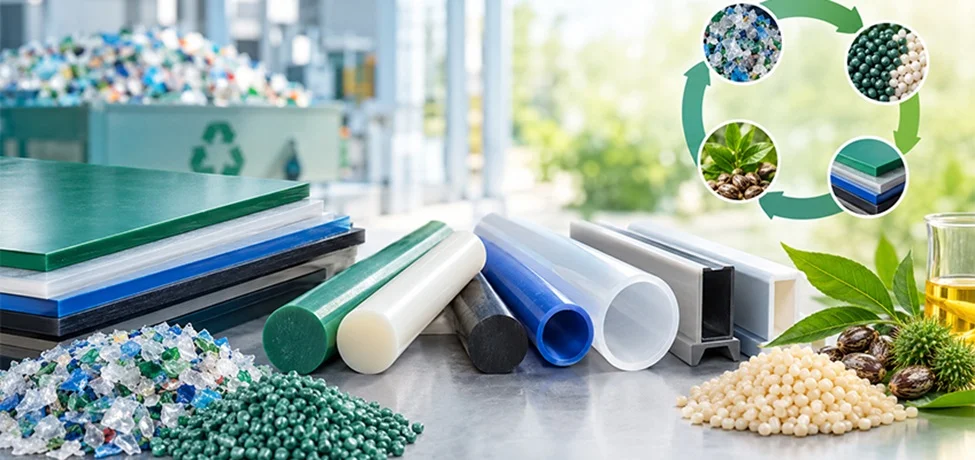
Sustainable semi-finished plastics are sheets, rods, tubes and profiles made from recycled or bio-based polymers, supplied in standard stock sizes that manufacturers machine, weld or thermoform into finished parts. They perform like conventional stock but cut reliance on virgin fossil feedstock. The two main routes are recycled plastics (reprocessed factory scrap or post-consumer waste) and bio-based plastics (made partly or fully from renewable sources such as sugarcane or castor oil).
Why manufacturers are switching now
Here's a question buyer now hear in almost every tender: what is this part made of, and how much of it is recycled?
Four pressures are behind it. Customers want lower-carbon products. Brands have set recycled-content goals. European rules on recycled content and product transparency keep getting stricter. And for most manufacturers, Scope 3 emissions begin with the raw materials on the purchase order.
Here's the good news. Semi-finished stock is the easiest place to start. You're not redesigning a product or retooling a mould. You're swapping the sheet or rod your machinists already cut, and the drawings often stay the same.
The old worry, that "recycled" means weaker or inconsistent, is also out of date. Better sorting, cleaner compounding and tighter quality control have changed what recycled plastic sheets for manufacturing can do.
Bio-based vs recycled plastics: which one fits?
The short answer: recycled plastics reduce waste and virgin demand, while bio-based plastics reduce fossil dependence. Neither is automatically better. The right pick depends on the part.
|
Factor |
Recycled plastics |
Bio-based plastics |
|
Source |
Reprocessed factory scrap or post-consumer waste |
Renewable feedstock such as sugarcane, corn or castor oil |
|
Main benefit |
Keeps existing plastic in use, lowers virgin demand |
Lowers fossil-carbon content |
|
Common materials |
rPET, rHDPE, rPP, recycled nylon (PA) |
PLA, bio-PA (e.g. PA 11), bio-PE, PHA |
|
Performance |
Close to virgin in many grades, but batch variation is possible |
Varies widely; some match fossil grades, others need design changes |
|
Watch out for |
Contamination, colour variation, traceability |
Cost, limited grades, disposal confusion |
|
Best for |
Wear parts, panels, fixtures, housings, pallets |
Technical parts needing lower fossil content, or products with bio-based claims |
Two myths are worth clearing up. Bio-based does not mean biodegradable. Bio-PE behaves like regular PE and is recycled the same way. And recycled does not mean low grade. Many recycled engineering plastics are specified, tested and certified like any other material.
Recycled engineering plastics and sheets for industrial use
Recycled engineering plastics are high-performance polymers, such as nylon, acetal (POM), PET and polycarbonate, made from reclaimed material and sold as sheet, rod or tube. Think of them as sustainable engineering plastics for parts that actually carry load.
The most common recycled plastic materials for industrial applications include:
- Recycled HDPE sheets: cutting boards, wear strips, machine guards, marine and outdoor panels
- Recycled PP sheets: tanks, fixtures, chemical-resistant liners
- Recycled PET (rPET) sheets: thermoformed trays, covers, protective housings
- Recycled nylon and acetal: gears, bushings, rollers, guide rails
What should you check before switching? Ask for the data sheet of the exact recycled grade, not a generic one. Compare tensile strength, impact resistance, moisture uptake and dimensional stability with your current virgin material. Then machine a trial batch.
One honest caveat: recycled stock can vary slightly in colour or density between batches. For structural or safety-critical parts, ask the supplier about batch consistency and testing. For jigs, fixtures, guards and non-visible components, the switch is usually painless.
Bio-based plastics for manufacturing
Bio-based plastics for manufacturing are made from renewable biomass instead of oil. Some are "drop-in" polymers, chemically identical to fossil versions, so they process the same way. Others, like PLA, are new materials with their own limits.
Where do they work best?
- Bio-PA (such as PA 11 from castor oil): a technical polymer for tubing, connectors and automotive parts
- Bio-PE and bio-PET: drop-in options when you want lower fossil content without changing processing
- PLA and PHA: better for short-life or low-heat uses, and often not suited to demanding engineering duty
Be careful with claims. "Bio-based" describes the raw material only. Ask how much of the carbon is renewable, how it's verified, and whether the supplier uses mass balance accounting. Third-party schemes such as ISCC PLUS exist for this reason.
Circular plastics manufacturing and the recycled plastics supply chain
Circular plastics manufacturing means designing a loop so material keeps its value instead of becoming waste. For semi-finished plastics, the loop looks like this:
1. Scrap or end-of-life plastic is collected and sorted by polymer type.
2. It's cleaned, shredded and compounded into consistent pellets.
3. Pellets are extruded or pressed into sheets, rods and profiles.
4. Manufacturers machine or form those into parts.
5. Offcuts and end-of-life parts go back into step 1.
That last step is where many factories leave money on the table. Machining waste from your own plant can often return to a recycler under a take-back arrangement, which closes the loop and shortens your supply chain.
The recycled plastics supply chain has real weak spots. Feedstock quality swings, traceability can be thin, and lead times shift when waste streams change. The fix is partnership, not guesswork: choose suppliers who can name their feedstock source, share batch data and hold recognized certifications such as GRS or RecyClass.
A practical checklist for sustainable materials procurement
Sustainable materials procurement works best when it's a repeatable process, not a one-off favour to the sustainability team. Before you approve a new supplier or grade, check:
- Recycled or bio-based content: is the percentage stated and documented?
- Certification: GRS, RecyClass, ISCC PLUS or equivalent, with a valid certificate
- Technical data: a data sheet for the exact grade, plus test results against your spec
- Batch consistency: how is colour, density and mechanical performance controlled?
- Traceability: can the supplier name the feedstock source?
- Trial first: machine or form a small batch before committing volume
- Supply security: is there a second source, and what are the lead times?
- End of life: can offcuts and used parts be taken back?
Start with low-risk parts like fixtures, guards and covers. Prove the case, then move up to more demanding components.
Frequently asked questions
Are recycled semi-finished plastics as strong as virgin plastics?
Many grades come close, and some applications can't tell the difference. Always compare the data sheet of the specific grade against your requirements.
What is the difference between bio-based and recycled plastics?
Recycled plastics are made from reprocessed plastic waste. Bio-based plastics are made from renewable raw materials. A material can also be both.
Can recycled engineering plastics be machined like virgin material?
Yes. Most can be milled, turned, drilled and welded with the same tools, though settings may need small adjustments.
Is bio-based plastic biodegradable?
Not necessarily. Biodegradability depends on the polymer's structure, not where its carbon came from.
How do I verify a supplier's recycled content claim?
Ask for third-party certification (for example GRS) and batch-level documentation, not just a marketing statement.
Where should a manufacturer start?
Pick one non-critical part, run a trial with a recycled grade, measure results, then scale.
The bottom line
Sustainable semi-finished plastics aren't a compromise any more. Recycled materials keep plastic in use, bio-based materials cut fossil dependence, and both fit into the stock formats your shop already handles.
You don't need to switch everything at once. Choose one part, one grade and one certified supplier, test it properly, and let the results make the case. Ready to start? Request data sheets and a trial batch from your supplier this week.
 Media Pack Download
 Newsletters
 Industrial Events