Advanced Plastic Recycling Technologies: Mechanical vs. Chemical Recycling for a Circular Economy
The Quick Answer
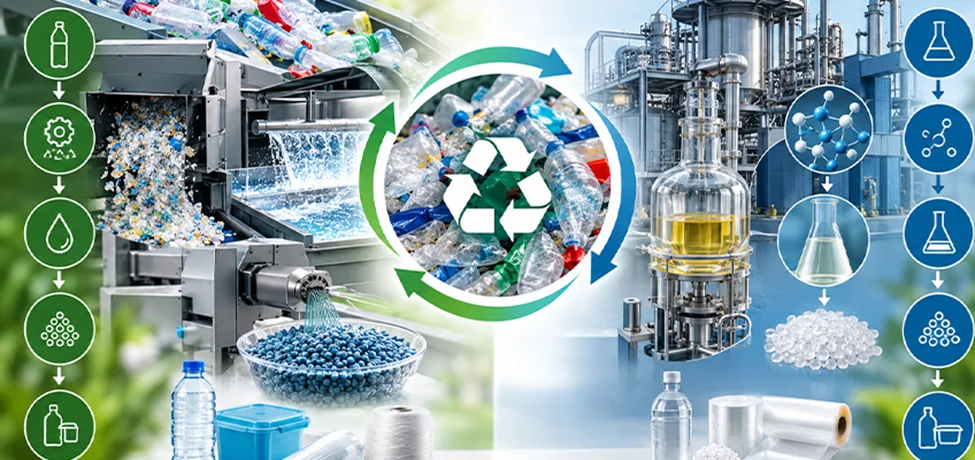
Mechanical recycling physically shreds, washes, and melts plastic into new pellets without changing its chemistry. It is cheaper and has a lower carbon footprint, but it works best on clean, single-type plastics.
Chemical recycling breaks plastic down into its molecular building blocks (monomers, oils, or gases) so it can be rebuilt into new plastic. It can handle mixed, dirty, and multilayer waste, but it is more energy-intensive and still scaling up.
The honest answer: neither wins alone. The most credible circular economy models use mechanical recycling first and chemical recycling for what mechanical can't handle.
Why Advanced Plastic Recycling Technologies Matter Now
Take a look at your recycling bin. Chances are the bottles, trays, pouches, and wrappers in it are technically "recyclable," yet most of them will never become new products. Globally, only a small fraction of plastic (roughly 9% by OECD estimates) is actually recycled into new material. The rest is landfilled, burned, or leaked into the environment.
Plastic packaging is the biggest culprit. It is designed to be light, cheap, and protective, not to be taken apart again. That's why advanced plastic recycling technologies have moved from research labs to boardroom agendas. Brands face recycled-content laws and extended producer responsibility (EPR) rules, and consumers want proof, not promises.
So which approach deserves the investment? Let's break it down.
What Is Mechanical Recycling of Plastics?
Mechanical recycling of plastics is the method most of us picture when we hear "recycling." The process is simple in concept:
1. Collection and sorting by polymer type (PET, HDPE, PP) and sometimes color
2. Shredding into small flakes
3. Washing to remove labels, glue, and food residue
4. Melting and extrusion into recycled pellets (rPET, rHDPE, and so on)
5. Remanufacturing into new bottles, containers, film, or fibers
Where it shines
- Lower cost and energy use: it's a mature, well-understood mechanical recycling technology
- Lower carbon footprint in most life-cycle assessments when input quality is good
- Proven at scale for PET bottles and HDPE containers
Where it struggles
- Quality loss: polymer chains shorten slightly each time plastic is melted, which is why recycled plastic is often "downcycled"
- Contamination sensitivity: food residue, inks, and mixed polymers reduce output quality
- Limited food-grade options for some polymers without extra decontamination steps
What Is Chemical Recycling of Plastics?
Chemical recycling of plastics covers a family of technologies that change plastic's molecular structure. Instead of just melting it, they break it down and rebuild it. Some people call it "advanced recycling" or "feedstock recycling."
The main chemical recycling technology routes include:
- Pyrolysis: heating plastic without oxygen to produce pyrolysis oil, which can be refined into new plastic feedstock. It is often used for polyolefins (PE and PP) and mixed flexible packaging.
- Depolymerization: breaking plastics like PET, nylon, or polystyrene back into monomers using glycolysis, methanolysis, or enzymes. It offers very high purity, and the output can match virgin quality.
- Solvent-based purification (dissolution): dissolving the target polymer and separating it from additives and contaminants, without breaking the chains completely.
- Gasification: converting waste into syngas, which can then become chemicals or fuels. It is the least "circular" route when the output isn't returned to plastic.
Where it shines
- Handles mixed, contaminated, and hard-to-recycle plastics
- Can produce virgin-quality material, including food-grade
- Complements the mechanical route rather than replacing it
Where it struggles
- Higher energy demand and, in some cases, higher emissions
- Higher capital costs and limited commercial scale
- Yield varies by technology and feedstock
- Transparency concerns: it matters whether output becomes new plastic or just fuel
Mechanical vs Chemical Recycling: Side-by-Side Comparison
Here is a quick plastic recycling technology comparison you can save or share:
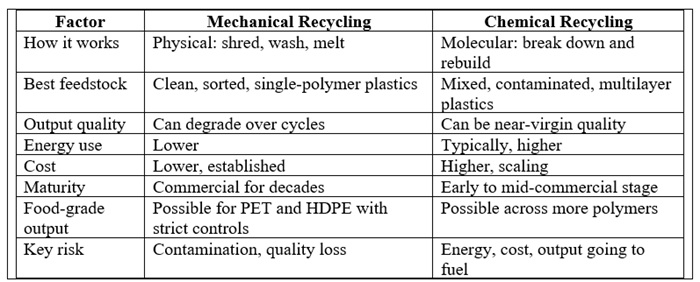
The takeaway: this is not a battle of good versus bad. It's a question of matching the technology to the waste stream.
Plastic Packaging Recycling Technologies: Which Waste Goes Where?
Packaging is a mixed bag, so let's map it out.
Best for mechanical recycling
- PET beverage bottles
- HDPE milk jugs and detergent bottles
- Clean PP tubs and caps
- Rigid, mono-material containers
Better suited to chemical recycling
- Soft, flexible films and pouches
- Heavily contaminated or mixed plastic waste
- Polyester textiles and colored or opaque PET trays
- Multilayer packaging that can't be separated
The sensible model is a cascade: collect and sort well, send the cleanest streams to mechanical recycling, and route the rest to chemical recycling instead of landfill or incineration.
The Multilayer Problem: Recycling Multilayer Plastic Packaging
If one category explains why recycling rates are stuck, it's this one. Think chip bags, snack wrappers, coffee pouches, and squeeze sachets. These combine several thin layers (polyethylene, polypropylene, nylon, EVOH, sometimes aluminum), each doing a specific job, like blocking oxygen or moisture.
That performance is exactly why recycling multilayer plastic packaging is so hard. Layers are fused together, and melting them produces a weak, inconsistent, lower-value blend.
Possible solutions
1. Design for recycling: switching to mono-material structures (all PE or all PP) that mechanical systems can process
2. Delamination and solvent-based separation: pulling layers apart so each polymer can be recovered
3. Pyrolysis-based chemical recycling of plastic packaging: converting mixed film into feedstock for new plastics
4. Compatibilizers: additives that help mixed polymers blend, improving the quality of mechanically recycled output
The most sustainable answer is usually upstream. Redesigning packaging is often better than inventing a new way to recycle a complicated one. But until every pouch is redesigned, chemical routes will play an important role for existing multilayer waste.
The Controversy Nobody Should Skip
- Any article that only praises chemical recycling isn't telling the full story. Critics raise fair questions:
- Is the output actually becoming plastic? If pyrolysis oil is burned as fuel, that isn't circular.
- What are the emissions? Life-cycle results depend heavily on the technology, energy source, and yield.
- How is recycled content counted? Mass balance accounting, which allocates recycled content on paper across a mixed output, is debated in regulation and among NGOs.
- Could it discourage reduction and reuse? If "we'll just recycle it" becomes a license to keep producing single-use plastic, the whole system loses.
On the other side, supporters point out that mechanical recycling alone cannot process everything, and that without new capacity, huge volumes of plastic remain destined for landfill.
The balanced position: chemical recycling is a complement, not a silver bullet. It should be judged by verified life-cycle data, transparent reporting, and real plastic-to-plastic output.
What a Circular Economy Actually Needs
Technology is only one piece. A functioning circular system for plastics needs:
- Reduction and reuse first: the best plastic is the one you never needed
- Better design: mono-materials, fewer additives, clear labelling
- Better collection and sorting: infrastructure, including AI-assisted sorting
- Clear policy: recycled-content targets, EPR schemes, and consistent accounting standards
- Both recycling routes working together: mechanical for efficiency, chemical for hard-to-recycle streams
How to Choose: A Simple Decision Guide
- Clean, single-polymer plastic → prioritize mechanical recycling
- Mixed, contaminated, or multilayer waste → evaluate chemical recycling for the residual stream
- Brand owner → redesign packaging first, then pair mechanical and chemical recycling partners
- Investor or policymaker → ask for verified life-cycle assessments, not just capacity claims
Frequently Asked Questions
What is the main difference between mechanical and chemical recycling?
Mechanical recycling physically reprocesses plastic without changing its chemical structure. Chemical recycling breaks plastic into molecular components to make new materials.
Which is better for the environment?
Mechanical recycling generally has a lower carbon footprint when the input is clean. Chemical recycling can be better than landfill or incineration for hard-to-recycle plastic, but results vary by technology.
Can chemical recycling replace mechanical recycling?
No. Most experts see them as complementary. Mechanical handles high-quality streams efficiently, while chemical addresses what's left over.
Can multilayer plastic packaging be recycled?
Yes, but with difficulty. Options include redesigning to mono-material, delamination and solvent separation, or chemical recycling such as pyrolysis.
Is chemical recycling the same as advanced recycling?
"Advanced recycling" is a broader, industry-preferred term that includes chemical routes such as pyrolysis, depolymerization, and solvent-based purification.
Is recycled plastic safe for food packaging?
It can be, when processes meet strict regulatory standards. PET bottle-to-bottle recycling is the best-established example.
Final Thoughts
If you remember one thing, make it this: mechanical vs chemical recycling isn't a rivalry, it's a division of labor. Mechanical recycling is the efficient workhorse. Chemical recycling is the specialist for the plastics that would otherwise fall through the cracks. Real progress comes from smarter design, better collection, honest accounting, and using each technology where it performs best.
The plastic problem won't be solved by one breakthrough. It will be solved by a system where every technology has a clear job.
 Media Pack Download
 Newsletters
 Industrial Events