AI and Smart Sorting Technologies: Revolutionizing Plastic Waste Recycling Efficiency
Every year, the world produces hundreds of millions of tons of plastic waste, yet only about 9% of it actually gets recycled. The problem isn't that people don't care. It's that recycling plants can't reliably tell one plastic from another, and a single wrong bottle in the wrong batch can turn a valuable bale into worthless junk.
For decades, the fix was human hands: workers standing beside fast-moving conveyor belts, picking out contaminants by sight. It was slow, tiring, and unsafe, and mistakes were inevitable.
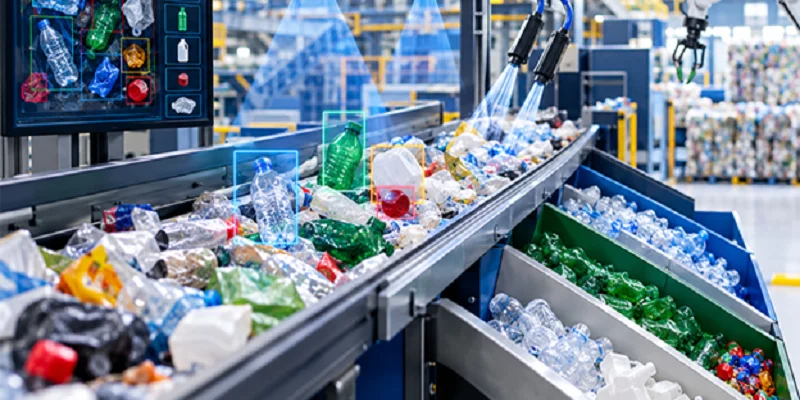
That's changing. AI plastic waste sorting uses cameras, sensors, and machine learning to identify plastics in milliseconds and separate them with remarkable precision, without fatigue or guesswork. It's quickly becoming the most important upgrade in modern recycling. Here's how it works, why it matters, and where it's headed.
Why Is Plastic Recycling So Inefficient Today?
Short answer: Most plastic recycling fails at the sorting stage. Plastics come in many polymers that can't be melted together, and mixed or contaminated batches produce low-quality material that nobody wants to buy.
The reasons are practical rather than mysterious:
- Too many polymer types. PET, HDPE, PVC, LDPE, PP, and PS all behave differently when melted. A few stray PVC bottles in a PET batch can ruin the whole lot.
- Look-alikes. A clear PET bottle and a clear PVC bottle look almost identical to the human eye.
- Contamination. Food residue, labels, caps, and multilayer packaging make everything harder.
- Human limits. Manual sorting is slow, inconsistent, and often unsafe.
Recyclers sell sorted plastic in bales, and buyers pay based on purity. Better sorting means better prices. That's why plastic waste sorting technology has become the heart of the recycling business case.
What Is AI Plastic Sorting?
Short answer: AI plastic sorting uses cameras, sensors, and machine learning to identify different types of plastic on a conveyor belt in real time, then automatically separates them using air jets or robotic arms.
Think of it as giving a recycling line eyes and a brain. Traditional systems relied on fixed rules: if a sensor detected a certain signal, a certain action followed. AI sorting technology for plastic recycling goes further. It learns from thousands of images and data points, so it can handle crushed bottles, faded colors, and odd shapes that would confuse a rule-based system.
How Does AI Plastic Sorting Work?
Here's the typical flow inside a modern automated plastic waste sorting facility:
- Feeding and spreading. Mixed waste is spread into a thin, single layer so every item is visible.
- Scanning. Cameras and spectral sensors capture each object as it passes.
- Identification. AI models classify the item by polymer, color, shape, and sometimes packaging type.
- Decision. Within milliseconds, the system decides where the item should go.
- Separation. Precisely timed air jets or robotic pickers divert the item into the right stream.
- Learning. The system keeps improving as it sees more material and receives feedback on its accuracy.
The whole cycle takes a fraction of a second. That's where the efficiency gains come from.
The Core Technologies Behind Smart Plastic Waste Sorting
Machine Vision for Plastic Sorting
Machine vision plastic sorting relies on high-resolution cameras paired with deep learning. The AI looks at shape, texture, color, and even printed labels. It's excellent at spotting things humans miss at speed, like a particular bottle design or a food-contaminated container.
Many facilities also use plastic sorting machine vision to track what's actually coming in. That data helps operators understand waste composition and tune their equipment.
AI Optical Sorting for Plastic
AI optical sorting plastic systems combine cameras with light-based sensors. The most common is near-infrared (NIR) spectroscopy. Different polymers reflect infrared light differently, giving each a spectral "fingerprint."
Traditional optical sorters could read these fingerprints, but AI makes the process smarter. It can tell a clean bottle from a dirty one and handle overlapping or partly hidden objects.
One well-known weak spot is black plastic, which absorbs most NIR light and often goes undetected. Newer approaches, including hyperspectral imaging paired with AI, are steadily closing that gap.
AI Polymer Identification in Recycling
AI polymer identification recycling is where things get interesting. Instead of only matching a spectrum to a database, machine learning models recognize patterns across many signals at once. They can flag plastics that are blended, coated, or layered and sort them into more specific grades.
Some systems can even separate food-grade from non-food-grade plastics. That matters, because recycled food-grade material is worth far more.
Robotics and Automation
AI-guided robotic arms now work alongside optical sorters. They pick items that air jets can't easily move, such as bulky objects or flat films. This is a big part of AI plastic recycling automation: taking over repetitive, hazardous tasks while people move into supervision and maintenance roles.
How Much Does AI Improve Plastic Sorting Efficiency?
Short answer: AI typically improves sorting accuracy, speed, and consistency compared to manual sorting, which means purer output, fewer rejected loads, and higher resale value for recycled plastic.
Exact numbers depend on the facility, the waste stream, and the equipment, so be skeptical of any source promising a magic percentage. But the gains tend to show up in the same places:
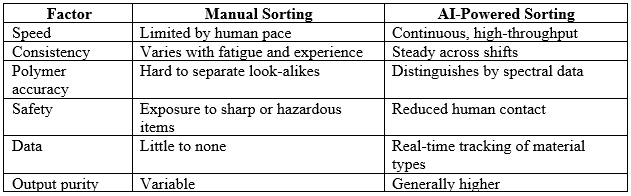
AI plastic sorting efficiency isn't only about speed. The real prize is purity. Cleaner bales sell for more, and recyclers can say yes to customers who demand high-quality recycled resin.
Why This Matters Beyond the Recycling Plant
It makes recycling more profitable. Recycling often struggles because the economics don't work. When sorting costs drop and output quality rises, more operations can stay open and more plastic gets a second life.
It supports recycled-content goals. Many brands have committed to using more recycled plastic in packaging. They can't do that without a reliable supply of high-quality material. AI recycling sorting systems help close that gap.
It generates useful data. Smart systems can report which packaging types show up and how recyclable they really are. That feedback can influence how manufacturers design packaging in the first place, which may be the biggest long-term impact of all.
What Are the Challenges?
AI isn't a silver bullet, and it's worth being honest about that.
- Upfront cost. Advanced sorting equipment is a serious investment, especially for smaller recyclers.
- Training data. AI is only as good as the examples it learned from. Unusual packaging can still trip it up.
- Messy reality. Dirty, crushed, or tangled waste remains difficult.
- Packaging design. Multilayer pouches and mixed-material items are hard to recycle no matter how smart the sorter is.
- Infrastructure gaps. Many regions still lack collection systems and sorting facilities altogether.
The best results come when technology pairs with better packaging design, clearer labeling, and public participation.
What's Next for AI Plastic Recycling Technology?
The direction of travel is clear:
- Finer sorting by grade, color, and food-contact status, not just basic polymer type.
- Smarter robotics that learn new items quickly.
- Better handling of dark plastics through improved sensors.
- Digital product identifiers such as watermarks and tags that let machines read a package's material instantly.
- Connected systems that share data across the supply chain, from collection to resin production.
AI plastic recycling technology is still maturing, but every year the gap between what's technically possible and what's commercially practical gets smaller.
Frequently Asked Questions
What is AI plastic waste sorting?
It's the use of artificial intelligence, cameras, and sensors to automatically identify and separate plastics by type so they can be recycled into high-quality material.
How does machine vision help sort plastic?
Machine vision uses cameras and deep learning to recognize an item's shape, color, texture, and labels in real time, allowing the system to classify and divert it in milliseconds.
Can AI identify different types of plastic?
Yes. Combined with spectral sensors like near-infrared, AI can recognize the signature of polymers such as PET, HDPE, and PP, even in messy, mixed waste.
Is AI sorting better than manual sorting?
In most industrial settings, it's faster, more consistent, and safer. Humans still play an important role in oversight, quality control, and handling items machines struggle with.
Can AI sort black plastic?
It's difficult with standard NIR sensors, but newer sensor technologies paired with AI are making black plastic detection more reliable.
Will AI solve the plastic waste problem on its own?
No. It's a powerful tool for improving recycling efficiency, but reducing plastic use, designing better packaging, and building collection systems matter just as much.
Final Thoughts
Recycling has always been a sorting problem in disguise. We've had the will to recycle for years, but not always the tools to do it well. AI plastic sorting is changing that by giving recycling facilities something they've never had at scale: speed, precision, and insight.
It won't fix everything. But when smart sorting, better packaging design, and informed consumers come together, recycling starts to look less like a good intention and more like a working system.
If you work in waste management, packaging, or sustainability, now is a good time to explore how smart plastic waste sorting could fit into your operations. And if you simply rinse and sort at home, know that your effort feeds into a system that's getting smarter every day.
 Media Pack Download
 Newsletters
 Industrial Events