
Circular Economy Technologies in the Plastics Industry
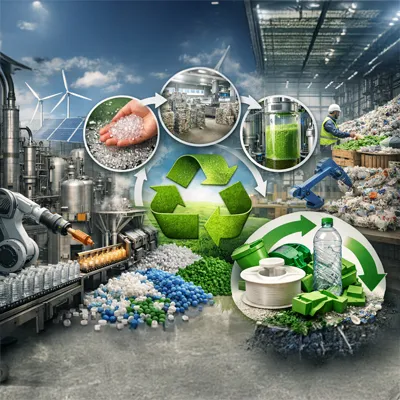
Introduction: Why Circular Economy Is Now a Business Imperative for Plastics Manufacturers
The structure of the global plastics industry is changing due to regulatory pressure, customer sustainability commitments, and fluctuation in the cost of raw materials and increasing interest in the environmental impact. The old, traditional linear models of plastics production, rooted in the principles of take-make-dispose, are less and less adequate in the modern realities of the industry and business. In retaliation, the circular economy plastics strategies can be viewed as a pillar of industrial plastics innovation.
The use of technologies in the form of a circular economy is not a hypothetical idea anymore in the case of B2B manufacturers, suppliers, and technology providers. They are cost effective, scalable systems that will improve the efficiency of plastics production whilst aligning operations to the sustainability requirements. Circular economy approaches in plastics are transforming the creation of value throughout the industrial supply chain through a wide range of strategies including advanced recycling and digital traceability, optimization of the process, and closed-loop manufacturing.
This article is about the way in which circular economy of plastics is changing the industrial manufacturing patterns, the technologies that make this possible and the strategic model ERP B2B organizations are embracing so that they can futurize their operations.
Definition: Circular Economy Plastics in an Industrial Context
Circular economy plastics are designed to be plastic materials that are designed, manufactured, used, recycles, and regenerated in cyclic systems. These systems also minimize dependency on virgin material, confer less waste, enhance resource efficiency, and increase the material life cycles and remain in the same performance standard and are needed in industrial applications.
The Industrial Drivers Accelerating Circular Economy Adoption
A number of overlapping forces are increasing the use of industrial sustainable plastics technology. The regulatory bodies in major markets have now enforced recycled contents, extended producer responsibility, and transparency of their lifecycle. Meanwhile, OEMs and brand owners are also driving sustainability demands down the supply chain, that circular compliance is a precondition to longer-term B2B deals.
The procurement strategies are also being redefined by the cost volatility of the raw materials that are fossil based. The circular economy strategies that plastics provide have a higher level of material security since they do not tie production to the virgin feedstock markets. Moreover, due to the development of optimization of the manufacturing process of plastics, circular solutions are technically and economically feasible in the application as a high-performance industrial solution.
Circular Economy Technologies Reshaping Plastics Manufacturing
Advanced Mechanical Recycling for Industrial Applications
Mechanical recycling today has developed to something much more than simple reprocessing. Sorting, washing and compounding technologies used on an industrial scale are currently able to generate recycled polymers that are of high mechanical, thermal and chemical standards. These inventions are also allowing manufacturers to incorporate the use of recycled content in high value applications like in the automobile component, industrial packaging, and even in construction material.
With real-time quality monitoring with the aid of AI-powered sorting systems, manufacturers are realizing stable material performance and are increasing the efficiency of plastics production. This movement is a fundamental move towards adopting circular economy of plastics on a large scale.
Chemical Recycling and Feedstock Regeneration
The approaches of chemical recycling are redefining the way plastic waste that is complex and contaminated is dealt with. The depolymerization, pyrolysis and gasification processes are used in the breakdown of plastics down to a molecular or feedstock level, enabling regenerated materials to re-enter the plastics manufacturing process optimization loop as near-virgin counterparts.
Chemical recycling is one of the routes to circularity in applications that cannot technologically be recycled through mechanical means, which is applied in B2B sustainable plastics manufacturing solutions. It also helps in compliance to regulation through the ability to trace, mass-balance-certified circular material.
Digitalization and Data-Driven Circular Economy Systems
Circular plastics are taking shape under the decisive impact of digital technologies in the industrial strategies. Plastics value chain execution systems, digital twins, and IoT-mediated monitoring tools offer greater transparency than ever before. Such technologies help manufacturers to trace material flows, control the creation of wastes and optimize the recycling loops in real time.
Recycled material and material provenance, as well as compliance with the rules of the circular economy, are recorded in blockchain-enabled traceability platforms more frequently. In case of the B2B customers, this openness creates trust and simplifies the audit and reporting process.
Table: Key Circular Economy Technologies and Their Industrial Impact
| Technology Area | Industrial Function | Business Impact |
| Advanced Mechanical Recycling | Material recovery and reprocessing | Reduced raw material costs and improved supply stability |
| Chemical Recycling | Feedstock regeneration | Enables circularity for complex plastics |
| Digital Traceability Systems | Material flow monitoring | Compliance, transparency, and risk reduction |
| AI-Driven Process Optimization | Manufacturing efficiency | Higher yield and lower waste |
| Closed-Loop Production Systems | End-of-life material reintegration | Long-term sustainability and cost control |
Process Optimization as the Backbone of Circular Manufacturing
The key to the success of the circular economy is the plastics manufacturing process optimization. Industrial manufacturers are redesigning production lines so as to minimize scrap generation, enhance energy efficiency and the recovery of materials can be easily achieved. Circular configurations can be tested virtually using process simulation tools where a significant amount of operational risk is reduced before being implemented.
The re-engineering of material formulation is also aimed at developing a better recyclability material without affecting performance. This solution will make sure that the plastics in the circular economy are industrially durable and still can be recycled through existing systems.
Implementing Circular Economy in Plastics: An Industrial Framework
Step 1: Circular Readiness Assessment
The manufacturers begin with mapping of the material flows, the waste streams, and the lifecycle impacts of the actions. This cost-calculated estimate determines the avenues of efficiency and circular integration.
Step 2: Technology Selection and Integration
Depending on the needs of the applications, firms choose adequate recycling, digital, and process optimization systems. Integration is designed to be in line with the current industrial logistics and manufacturing systems so that continuity is maintained.
Step 3: Supplier and Partner Alignment
The plastics of the circular economy strategies involve working together on the value chain. The customers, recyclers, logistics providers, and the suppliers of raw materials should make an agreement on the material standards and share of information.
Step 4: Performance Measurement and Continuous Improvement
The main performance pointers that are continually checked to improve the circular strategies are the use of recycled content, energy efficiency, waste reduction and life cycle emissions.
Industry Q&A: Addressing Common B2B Concerns
Can circular plastics meet industrial performance standards?
Circular plastics can now match or even surpass traditional requirements in most industrial applications, having been used in automotive, packaging, and electronics among others due to the advancement in material science and control of processes.
Is circular manufacturing cost-effective for B2B producers?
First investments might be needed, but in the long term one will see saved material costs, minimized regulatory risks, and increased benefits in customer retention.
How does circularity affect supply chain resilience?
Circular systems decrease reliance on virgin feedstocks and world supply volatility and increase the degree of stability in operations.
Circular Economy as a Competitive Differentiator in B2B Markets
Circular economy plastics are also emerging as a strategic differentiator in addition to compliance. Customers in the industry are putting more emphasis on suppliers that are capable of showing quantifiable sustainability results. Those companies who incorporate industrial sustainable plastics technologies are awarded with preferential access to contracts, partnerships and endeavors in emerging markets.
Circularity also enables innovation, where new forms of business like material-as-a-service, take-back schemes and joint development with customers can be made.
Glossary: Key Circular Economy Terms for Plastics Industry Professionals
Circular Manufacturing is the concept of manufacturing based on material recovery and reuse.
Closed-Loop Systems define systems in which there is a cyclic flow of materials with a single value chain.
Feedstock Recycling entails recycling of waste plastics into raw material equivalents.
Lifecycle Assessment assesses the level of environmental impact over the lifecycle of a product.
The Mass Balance Certification is used to monitor recycled content via a complicated supply chain.
The Road Ahead: Scaling Circular Economy Technologies
The innovation of industrial plastics in the future is based on the mass scale of circular economy technologies in the international system of manufacturing. Further investment in recycling systems, digitalisation and cross-industry cooperation will make the adoption faster. It is also expected that governments and industry bodies will create harmonies in standards and thus less fragmentation and faster deployment.
In the case of B2B organizations, the issue of the shift to the circular economy plastics does not concern whether, but rather how fast and efficient it can be implemented.
Conclusion: Circular Economy as the New Operating Model for Plastics Manufacturing
The technologies of the circular economy are transforming the plastics industry into a more sustainable, effective, and efficient manufacturing environment as opposed to the previous linear framework with substantial resource consumption. Active participation and incorporation of enhanced recycling, computer enhancement, and joint supply chain plans will enable industrial participants to attain efficiency in production of plastics and fulfill the requirement of sustainability.
The idea of using circular economy in plastics is no longer a sustainability niche project. It is a fundamental Industrial policy, which provides business resiliency, regulatory adherence, and long-term business expansion. In the case of sustainable manufacturing solutions of plastics to business, the concept of circularity is a duty and a competitive edge in the changing international market.
 Media Pack Download
 Newsletters
 Industrial Events