Industry 4.0 in Plastics Processing: Connecting Auxiliary Equipment through IoT and Predictive Maintenance
For decades, auxiliary equipment has been treated as the supporting cast in plastics manufacturing. The injection molding machine or extruder gets the attention, the dashboards, and the operator’s full focus— while the dryers, chillers, and granulators running alongside them are left to operate as isolated black boxes, mostly invisible until something breaks.
That's changing fast, and it's changing because of Industry 4.0 in plastics processing. Manufacturers are no longer content to let dryers, chillers, mold temperature controllers, and material handling systems operate as isolated black boxes. They're connecting them, monitoring them, and — increasingly — predicting their failures before they happen. This shift isn't a distant trend anymore. It's happening on plant floors right now, and the companies that adopt it early are seeing real, measurable gains in uptime, quality, and cost control.
| Also Read: Automation and Robotics in Plastics Manufacturing: The Future of High-Speed, Low-Labor Production |
Why Auxiliary Equipment Was the Blind Spot
For years, plastics processors poured investment into the primary machines — the injection molders, the blow molders, the extrusion lines. That makes sense; those machines directly shape the product. But plastic parts don't come out right if the resin wasn't dried properly, if the mold temperature drifted, or if the cooling water wasn't at the right flow rate. Auxiliary equipment doesn't just support the process — it is the process, just less visible.
The problem is that most of this equipment historically ran on its own logic, disconnected from any central system. A dryer might have a basic control panel showing temperature and dew point, but that data lived and died on that little screen. Nobody was logging it, trending it, or comparing it against what happened last week. When a bearing started to wear out or a heater element began to fail, there was no early signal — just a sudden stoppage, a scrap batch, or an unplanned shutdown that could cost thousands of dollars an hour.
This is exactly the gap that IoT in plastics manufacturing is closing.
What IoT Actually Looks Like on the Shop Floor
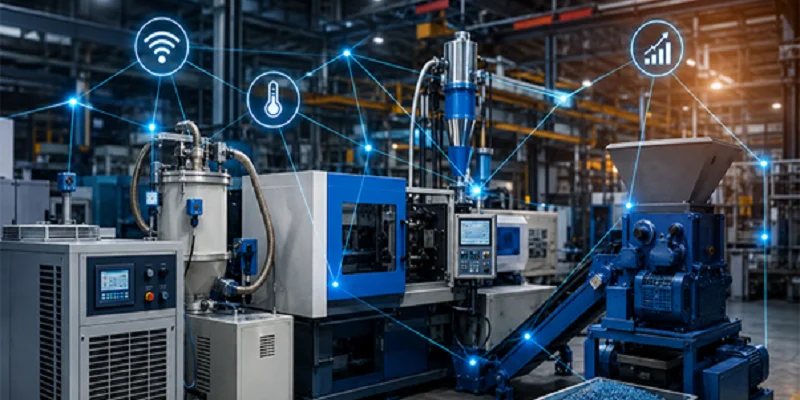
It helps to demystify this a bit, because "IoT" can sound abstract until you see it applied. In practice, Industrial IoT for plastics means attaching sensors — vibration, temperature, pressure, current draw, humidity, flow rate — to auxiliary equipment and streaming that data to a central platform in real time. A dryer's dew point, a chiller's compressor load, a granulator's blade vibration, a conveyor's motor current: all of it becomes visible, searchable, and comparable over time.
The bigger shift is what happens after the data is collected. This is where Industrial Internet of Things (IIoT) platforms differ from old-fashioned SCADA systems. IIoT isn't just about displaying numbers on a screen — it's about connecting every piece of equipment into a single ecosystem where machines, sensors, and software talk to each other and to the people running the plant. A mold temperature controller can flag an anomaly, and that alert can automatically trigger a maintenance ticket, notify a technician's phone, and log the event against that specific machine's history — all without a human manually checking a gauge.
This is the foundation of what people now call connected manufacturing equipment: not machines that simply run, but machines that report, communicate, and in some cases, adjust themselves.
Predictive Maintenance: From Reactive to Proactive
Here's where the real financial impact shows up. Traditional maintenance in plastics plants has typically followed one of two models: reactive (fix it when it breaks) or preventive (replace parts on a fixed schedule, whether they need it or not). Both approaches waste money — reactive maintenance causes unplanned downtime and rushed repairs, while preventive maintenance often replaces perfectly good components simply because a calendar said so.
Predictive maintenance in plastics processing flips this model. By continuously monitoring equipment condition through sensors and analyzing that data with machine learning algorithms, plants can detect the subtle signs of wear — a slight increase in vibration, a small rise in motor temperature, a gradual drop in flow efficiency — long before a breakdown occurs. Instead of guessing when a chiller compressor might fail, the system can flag it weeks in advance based on actual performance trends, giving maintenance teams time to plan the repair during scheduled downtime rather than scrambling during a production run.
This is what predictive equipment maintenance delivers in practical terms:
- Fewer unplanned shutdowns. Catching a failing bearing or heater element before it fails outright avoids the domino effect of a stopped line, scrapped material, and missed shipping deadlines.
- Lower maintenance costs. Parts get replaced when they actually need it, not on an arbitrary schedule, and not after they've already failed and damaged something else.
- Better product quality. A drifting dryer or an inconsistent chiller directly affects part quality. Catching equipment issues early means catching quality issues early too.
- Longer equipment lifespan. Consistent, condition-based care keeps auxiliary equipment running well past what reactive maintenance schedules typically allow.
Smart Plastics Manufacturing Is a Systems Approach
It's tempting to think of this as simply "adding sensors," but smart plastics manufacturing is really about connecting the dots between systems that used to operate independently. A resin dryer, a chiller, a mold temperature controller, and the injection molding machine itself all influence each other. If the dryer isn't hitting the right dew point, the molder compensates in ways that can mask the real problem — until scrap rates creep up and nobody can pinpoint why.
Smart manufacturing systems solve this by giving plant managers a unified view. Instead of six different screens showing six different machines in isolation, operators get a single dashboard that correlates data across the entire process. If a quality issue shows up in the finished part, the system can help trace it back — was it the dryer, the mold temperature, the cooling rate, or something upstream in material handling? That kind of visibility was nearly impossible when auxiliary equipment operated as disconnected islands.
This is also where the concept of connected auxiliary equipment becomes a competitive differentiator, not just a technical upgrade. Plants that connect their dryers, chillers, granulators, conveyors, and temperature controllers into one IIoT ecosystem aren't just collecting more data — they're building a feedback loop that continuously improves how the entire line runs.
Getting Started: A Practical Path, Not an Overnight Overhaul
One reason plastics processors hesitate to adopt Industry 4.0 practices is the assumption that it requires ripping out existing equipment and starting fresh. That's rarely the case. Most auxiliary equipment manufacturers now offer retrofit sensor kits and IIoT gateways that can be added to existing dryers, chillers, and controllers without replacing the machines themselves.
A realistic adoption path typically looks like this:
- Start with the equipment that causes the most downtime. Identify which auxiliary systems have historically caused the most unplanned stops or quality issues, and connect those first.
- Establish a data baseline. Before predictive algorithms can flag anomalies, the system needs weeks or months of normal operating data to understand what "normal" actually looks like for each machine.
- Integrate alerts into existing workflows. Predictive maintenance only works if the alerts reach the right people at the right time — through existing maintenance software, not a separate system nobody checks.
- Expand gradually. Once the first connected machines prove their value, extend the same approach across the rest of the auxiliary equipment fleet.
This incremental approach means plants don't need a massive capital investment to start seeing results. Even connecting a handful of high-impact machines can produce meaningful reductions in downtime within the first few months.
The Bottom Line
Industry 4.0 in plastics processing isn't a futuristic concept anymore — it's a practical, achievable upgrade that's already reshaping how plants operate. Connecting auxiliary equipment through IoT and applying predictive maintenance strategies turns previously invisible machines into active participants in plant intelligence. The result is fewer surprises, lower costs, better quality, and equipment that lasts longer because it's cared for based on actual condition, not guesswork.
For plastics processors weighing where to invest next, the auxiliary equipment fleet — long overlooked — may offer some of the fastest, most measurable returns available today.
Frequently Asked Questions
What is Industry 4.0 in plastics processing?
Industry 4.0 in plastics processing refers to the use of connected sensors, IoT platforms, and data analytics to monitor and optimize both primary machines (like injection molders) and auxiliary equipment (like dryers, chillers, and granulators) in real time, enabling smarter, more automated manufacturing decisions.
How does IoT improve plastics manufacturing?
IoT in plastics manufacturing connects equipment sensors to centralized platforms, allowing plants to track temperature, vibration, pressure, and other performance metrics continuously. This visibility helps identify inefficiencies, prevent breakdowns, and improve overall part quality.
What is predictive maintenance in plastics processing?
Predictive maintenance uses real-time equipment condition data and analytics to forecast when a machine component is likely to fail, allowing maintenance teams to repair or replace it before an unplanned breakdown occurs.
What auxiliary equipment can be connected through IIoT?
Common connected auxiliary equipment includes resin dryers, chillers, mold temperature controllers, granulators, conveyors, and material handling systems — all of which directly affect part quality and production uptime.
Is predictive maintenance expensive to implement?
Not necessarily. Many plants start with retrofit sensor kits on their highest-downtime equipment, allowing for a gradual, budget-friendly rollout rather than a complete system overhaul.
 Media Pack Download
 Newsletters
 Industrial Events