Automation and Robotics in Plastics Manufacturing: The Future of High-Speed, Low-Labor Production
The plastics industry is going through one of the biggest operational shifts in its history, and it's happening faster than most people outside the sector realize. Plastic Manufacturing Automation has moved from a nice-to-have upgrade to a survival requirement, and the shift is reshaping how manufacturers think about speed, cost, and labor.
If you're researching Robotics in Plastics Manufacturing because you're trying to decide whether your facility needs to automate, you're not alone. Rising labor costs, chronic staffing shortages, and relentless pressure to produce more with fewer errors have pushed plastics companies of every size to look seriously at automation. This article breaks down what's actually happening in the industry, why it matters, and what to expect if you're considering making the leap.
Why Plastic Industry Automation Is Accelerating Right Now
A few years ago, automation was mostly something large-scale manufacturers experimented with. Today, Plastic Industry Automation is showing up in mid-sized and even small plants. Three forces are driving this:
Labor shortages that aren't going away. Manufacturing has struggled for years to fill machine operator, material handler, and quality inspector roles. Younger workers aren't lining up for repetitive floor jobs, and experienced operators are retiring faster than they can be replaced. Automation isn't replacing people out of greed — for many plants, it's the only way to keep production lines staffed at all.
Speed expectations from customers. Buyers want shorter lead times, smaller batch runs, and faster turnaround on custom parts. Human-paced production simply can't keep up with these demands at scale.
The falling cost of robotics. Industrial robots that once cost six figures and required specialized engineers to program are now more affordable, easier to set up, and faster to deploy. That price drop has opened automation up to companies that never thought it was within reach.
What Automated Plastic Production Actually Looks Like
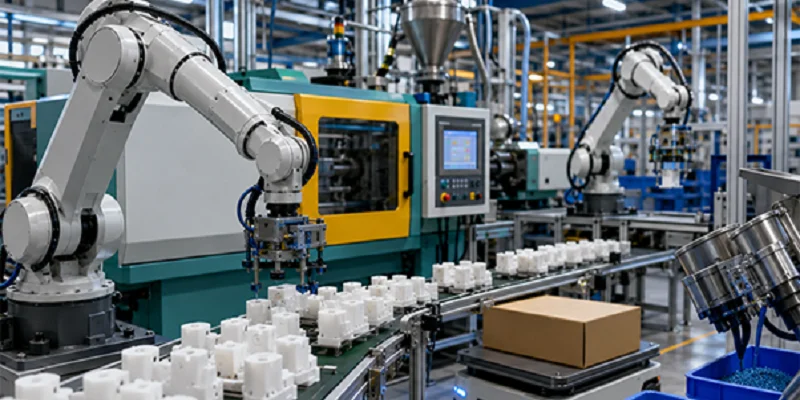
Automated Plastic Production isn't a single machine — it's a chain of connected systems working together. A typical automated plastics line includes:
- Injection molding machines running continuously with minimal operator intervention
- Robotic arms that remove parts from molds the instant they're finished
- Conveyor and sorting systems that move finished parts to packaging or inspection
- Vision systems that catch defects in real time, before a bad part ever reaches a customer
- Automated material feeders that keep raw plastic pellets flowing without anyone manually refilling hoppers
When these pieces work together, a plant can run lights-out shifts — production continuing overnight with little to no staff on-site. That's not a futuristic concept anymore; it's happening in facilities across North America, Europe, and Asia right now.
Industrial Robots for Plastics: The Workhorses of the Modern Floor
Industrial Robots for Plastics manufacturing generally fall into a few categories, each suited to different tasks:
Six-axis robotic arms are the most common. They handle part removal, trimming, assembly, and packaging with a level of precision and repeatability no human hand can consistently match over an eight-hour shift.
SCARA robots excel at fast, repetitive pick-and-place work, especially where speed matters more than heavy lifting.
Gantry robots move along a fixed overhead track and are ideal for larger parts or facilities where floor space is tight.
Delta robots, with their spider-like design, are built for extremely fast, lightweight sorting — think small plastic components moving at blistering speed on a conveyor.
Each of these Plastics Manufacturing Robots brings something different to the table, and most automated plants use a combination depending on the part size, cycle time, and complexity involved.
Robotic Automation in Manufacturing: Beyond Just Molding
It's worth noting that Robotic Automation in Manufacturing for plastics doesn't stop at the molding machine. Automation now touches nearly every stage of the process:
- Raw material handling and blending
- Mold changing (automated mold-change systems can swap tooling in minutes instead of hours)
- Quality inspection using AI-powered vision systems
- Secondary operations like ultrasonic welding, printing, and assembly
- Packaging and palletizing at the end of the line
This end-to-end approach is what separates a genuinely automated plastics factory from one that's just added a single robot to an otherwise manual process.
Automated Plastic Processing and Cycle Time Gains
One of the biggest arguments for automation is speed. Automated Plastic Processing consistently outperforms manual methods because robots don't get tired, don't need breaks, and don't lose focus after hour six of a shift.
Consider a simple example: a human operator removing parts from an injection mold might take 8–10 seconds per cycle, factoring in fatigue and inconsistency. A robotic arm doing the same task can do it in 2–3 seconds, every single time, without variation. Multiply that across thousands of cycles a day, and the throughput difference becomes massive.
This is why High Speed Plastic Manufacturing and robotics go hand in hand — you genuinely cannot hit today's production speed benchmarks with manual labor alone, not at competitive cost.
Robotic Plastic Handling and Material Movement
Beyond part removal, Robotic Plastic Handling covers everything involved in moving materials through a facility — from raw pellets to finished, packaged goods.
Automated Material Handling Plastics systems typically include automated guided vehicles (AGVs) or autonomous mobile robots (AMRs) that transport materials between workstations without a forklift driver. Combined with robotic pick-and-place systems, this creates a nearly continuous flow of material through the plant, cutting down on the bottlenecks that come from waiting on human transport.
Robotic Pick and Place Plastics systems specifically are one of the fastest-growing applications in the industry, because they solve a problem every plastics manufacturer has: sorting, orienting, and placing finished parts quickly and accurately, over and over, without error.
Labor Saving Manufacturing Automation: What It Really Means for Staff
There's a common fear that automation simply means fewer jobs. The reality on most factory floors is more nuanced. Labor Saving Manufacturing Automation typically shifts labor rather than eliminating it entirely — fewer people are doing repetitive, physically taxing tasks, and more are moving into roles overseeing, programming, and maintaining the automated systems.
That said, it's honest to acknowledge that automation does reduce headcount needs for certain repetitive roles. For manufacturers, this translates into lower labor costs, reduced injury rates (repetitive strain injuries are extremely common in manual plastics handling), and more predictable staffing — you're not scrambling to fill three open machine operator positions during a labor shortage.
Collaborative Robots Plastics Manufacturing: Automation without the Big Investment
Not every plant is ready for a fully automated factory, and that's where Collaborative Robots Plastics Manufacturing — commonly called cobots — come in. Unlike traditional industrial robots that operate behind safety cages, cobots are designed to work alongside human employees safely, without extensive fencing or specialized safety zones.
Cobots are typically cheaper, faster to install, and easier to reprogram for new tasks, making them a practical entry point for small and mid-sized plastics manufacturers who want the benefits of automation without the capital expense of a full robotic line. A single cobot handling part removal or packaging can free up a worker for higher-value tasks elsewhere on the floor.
Building an Automated Plastics Factory: Where to Start
For manufacturers considering the shift, the path to becoming an Automated Plastics Factory doesn't have to happen all at once. Most successful automation projects follow a similar pattern:
- Identify the biggest bottleneck — usually part removal, packaging, or material handling
- Start with a single robotic cell rather than automating the entire line at once
- Measure results in cycle time, defect rate, and labor cost before expanding
- Scale gradually, adding vision systems, AGVs, and additional robotic stations as ROI is proven
This incremental approach reduces risk and gives plant managers real data to justify further investment.
Frequently Asked Questions
Is automation only worth it for large plastics manufacturers?
No. Cobots and modular robotic cells have made automation accessible to small and mid-sized plants, often with a return on investment within one to three years.
Will robots completely replace human workers in plastics manufacturing?
Unlikely in the near term. Most facilities use automation to handle repetitive, physically demanding tasks while employees shift into oversight, programming, and quality roles.
What's the typical ROI timeline for plastics automation?
Many manufacturers see payback within 12 to 36 months, depending on labor costs, production volume, and the complexity of the automated process.
Do collaborative robots require safety cages like traditional industrial robots?
Generally no. Cobots are designed with built-in sensors and force limits that allow safe operation near human workers without extensive fencing.
What's the first process most plants should automate?
Part removal and pick-and-place packaging are usually the easiest and most cost-effective places to start.
The Bottom Line
The plastics industry isn't automating because it's trendy — it's automating because the math works. Faster cycle times, lower defect rates, reduced injury risk, and relief from chronic labor shortages make Plastic Manufacturing Automation one of the clearest ROI stories in modern manufacturing. Whether that means a single cobot handling packaging or a fully integrated automated production line, the direction is clear: the future of plastics manufacturing is faster, leaner, and increasingly run by robots working alongside a smaller, more specialized human team.
 Media Pack Download
 Newsletters
 Industrial Events