AI-Driven Custom Masterbatch Formulation: How Digital Technologies Are Transforming Plastic Compounding
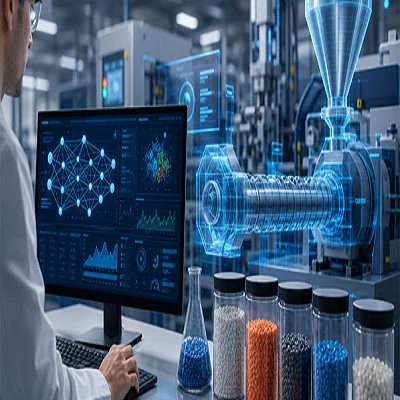
Walk into almost any compounding facility today and you'll still see the same core equipment that's defined the industry for decades — extruders, feeders, mixers, and quality labs running color and physical property checks by hand. But look a little closer, and something has changed. Screens now show live predictions instead of just readouts. Formulators are running simulations before they ever touch a batch. And decisions that used to take days of trial runs are being made in hours. This is the quiet but unmistakable arrival of AI in plastic manufacturing, and nowhere is its impact more visible than in custom masterbatch formulation.
For years, masterbatch development has been treated as equal parts science and craft. Skilled formulators relied on experience, intuition, and a lot of iterative testing to get color, additive loading, and performance properties just right. That approach worked, but it was slow, resource-intensive, and hard to scale as customer demands grew more specific and product lifecycles shrank. Today, a new generation of digital tools is rewriting that playbook, and the companies embracing it are pulling ahead of competitors still running on legacy methods.
Why Traditional Compounding Is Reaching Its Limits
Custom masterbatch formulation has always been a balancing act. A single change — swapping a pigment, adjusting a dispersing agent, or tweaking carrier resin — can ripple through dozens of downstream properties: melt flow, tensile strength, UV stability, and colorfastness, to name a few. Traditionally, getting this balance right meant running physical trials, measuring outcomes, adjusting, and repeating. Each cycle consumes raw material, machine time, and skilled labor.
As customer requirements have become more specialized — think medical-grade compounds, automotive interior components with strict VOC limits, or packaging films requiring precise barrier properties — the number of variables formulators must juggle has multiplied. Manual, trial-and-error methods simply can't keep pace with that complexity while still meeting tight development timelines. This is exactly the gap that AI plastic compounding is stepping in to close.
What AI-Driven Formulation Actually Looks Like
At its core, AI material design applies machine learning models to historical formulation data, raw material properties, and processing parameters to predict how a new compound will behave before it's ever produced. Instead of formulating blind and testing afterward, engineers can simulate dozens or even hundreds of formulation variants virtually, narrowing the field down to the handful most likely to succeed.
This is where machine learning for plastics delivers real, measurable value. Algorithms trained on years of formulation outcomes can identify non-obvious relationships between ingredients and final properties — patterns that might take a human formulator a career to notice intuitively. Need a masterbatch that hits a specific Pantone shade while maintaining impact resistance and processing at a lower temperature? A well-trained model can suggest candidate formulations ranked by likelihood of success, dramatically cutting the number of physical trials needed.
This isn't about replacing experienced formulators. It's about giving them a sharper set of tools. The best implementations pair algorithmic suggestions with expert review, so human judgment still guides final decisions — just with far better data behind them.
Digital Twins: Testing Before You Touch a Machine
One of the more powerful developments supporting this shift is the digital twin for plastics — a virtual replica of a compounding line, extruder, or entire production process. These digital models simulate how a formulation will behave under real processing conditions, accounting for variables like shear rate, temperature profiles, and residence time.
Instead of committing production capacity to test a new formulation, engineers can run it through the digital twin first, catching potential issues like poor dispersion or thermal degradation before they ever occur on the shop floor. For contract compounders and masterbatch producers juggling dozens of custom orders simultaneously, this capability is a genuine competitive advantage. It shortens development cycles, reduces scrap rates, and lets teams offer customers faster turnaround without sacrificing quality.
From Guesswork to Predictive Analytics
Perhaps the most transformative shift is the move from reactive problem-solving to proactive prediction. Predictive polymer analytics uses data from past batches, environmental conditions, and equipment performance to forecast outcomes before production even begins. Instead of asking "what went wrong with this batch?" after the fact, teams can ask "what's likely to go wrong, and how do we prevent it?" beforehand.
This predictive capability extends naturally into AI material optimization, where algorithms don't just predict outcomes but actively suggest adjustments to hit target specifications more efficiently. Want to reduce pigment loading without sacrificing color strength? Looking to substitute a costlier additive with a more sustainable alternative while maintaining mechanical properties? These are exactly the kinds of multi-variable optimization problems where AI models outperform manual calculation, especially when dozens of interacting variables are in play.
Together, these capabilities represent what many in the industry are calling intelligent material formulation — a system where data, not just experience, drives the development process from the very first concept to final production approval.
Quality Control Gets a Digital Upgrade
Formulation is only half the story. Getting a compound right on paper means little if quality can't be consistently maintained at scale. This is where AI quality control in plastics is making a substantial difference. Machine vision systems paired with AI algorithms can now detect color deviations, contamination, and dispersion issues in real time — catching problems that might slip past periodic manual sampling.
Rather than relying solely on end-of-batch testing, AI-enabled quality systems monitor continuously, flagging anomalies as they emerge. This shift from reactive inspection to real-time monitoring reduces waste, minimizes costly recalls, and builds the kind of consistency that customers in demanding sectors — automotive, medical devices, food packaging — increasingly require as a baseline expectation rather than a premium feature.
The Bigger Picture: Industry 4.0 Meets Plastic Processing
None of these individual technologies exist in isolation. Together, they represent a broader transformation often described under the umbrella of Industry 4.0 plastic processing — the integration of sensors, data analytics, automation, and connected systems across the entire manufacturing environment.
In practice, this means formulation software, production equipment, and quality systems are no longer siloed. Data flows between them continuously, creating a feedback loop where insights from production inform future formulation decisions, and formulation data helps calibrate production parameters. This is the essence of digital plastic manufacturing — not a single tool, but an interconnected ecosystem where information moves as freely as material does.
For compounders, this connectivity translates into smart polymer compounding capabilities that were simply impossible a decade ago: automated adjustment of processing parameters based on real-time material behavior, predictive maintenance that flags equipment issues before they cause downtime, and formulation libraries that grow smarter with every batch produced.
What This Means for AI-Driven Process Optimization on the Floor
It's worth being clear-eyed about what AI-driven process optimization looks like in day-to-day operations, because the reality is less dramatic than the marketing often suggests. It's not about handing over control to a black box. It's about equipping experienced teams with better decision-support tools.
A formulator might still make the final call on a new masterbatch recipe, but now they're doing so with a ranked shortlist of viable options instead of starting from a blank page. A process engineer might still walk the production floor, but now they're guided by real-time dashboards flagging subtle drift in melt viscosity before it becomes a rejected batch. The technology augments expertise rather than replacing it, and the companies seeing the strongest results are the ones that treat it that way.
Practical Considerations for Companies Getting Started
Adopting these digital manufacturing solutions doesn't require an all-at-once overhaul. Most successful implementations start narrow: a single product line, a specific quality parameter, or one persistent formulation challenge. Early wins build internal confidence and generate the clean, structured data needed to train more ambitious models down the line.
Data quality matters more than model sophistication in the early stages. A company with years of well-documented formulation records and production data has a significant head start over one with sophisticated software but patchy historical data. It's also worth involving formulators and process engineers directly in tool selection and rollout — the people who understand the nuances of a compound's behavior are best positioned to judge whether an AI system's recommendations actually make sense.
Vendor selection deserves careful scrutiny too. Not every platform marketed as "AI-powered" delivers genuine predictive capability; some are little more than digitized versions of existing spreadsheets. Ask specific questions about the underlying data the model was trained on, how predictions are validated against real outcomes, and how the system handles the inevitable cases where its suggestions don't pan out.
Looking Ahead
The shift toward AI-driven formulation and digital compounding tools isn't a distant possibility — it's already reshaping how leading manufacturers compete. Companies that build these capabilities now are positioning themselves to respond faster to custom orders, reduce material waste, and maintain tighter quality control than competitors still relying on manual methods alone.
For an industry built on precision and consistency, that's not just an efficiency gain. It's a fundamentally better way of working — one where decades of formulation expertise are amplified, not replaced, by the data-driven tools now available. The compounders who recognize this early, and invest accordingly, are the ones who will define what custom masterbatch development looks like for the next decade.
 Media Pack Download
 Newsletters
 Industrial Events