Advanced Plastic Recycling Technologies: Mechanical vs. Chemical Recycling for a Circular Economy
Most of us have stood over a bin with a yogurt cup in hand, wondering whether it really gets recycled. The honest answer is that it depends on what the cup is made of, how clean it is, and what technology is waiting at the other end.
That last part is changing quickly. For decades, recycling meant one thing: collect, sort, shred, melt. Today, advanced plastic recycling technologies are opening up a second path for the plastics the old system couldn’t handle. The debate around mechanical vs chemical plastic recycling gets heated, but it is less a rivalry than a division of labor.
What counts as advanced plastic recycling?
“Advanced recycling” is an umbrella term. It covers improved sorting (AI-guided optical sorters, chemical tracers, digital watermarks), better mechanical processes (solvent-based purification, high-grade washing), and chemical recycling methods that change the plastic at the molecular level.
The goal is the same across all of them: keep plastic in use for as long as possible and stop treating it as a one-way product.
How does mechanical plastic recycling work?
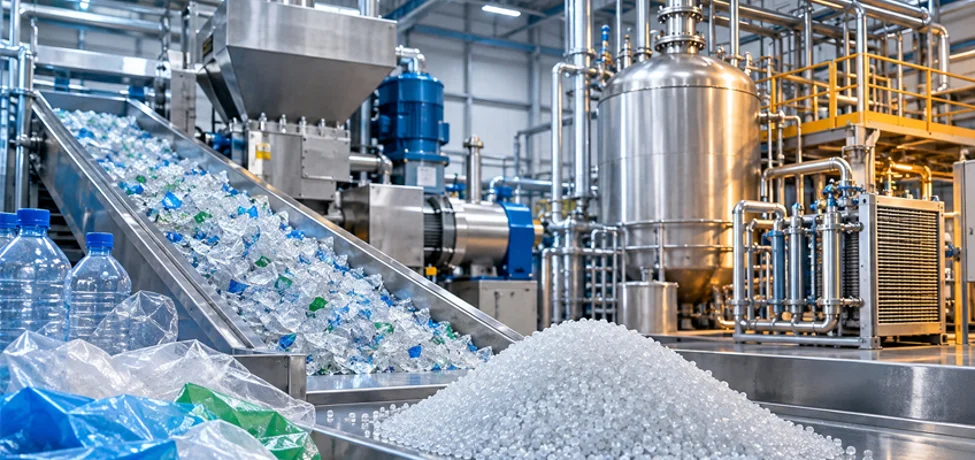
The mechanical plastic recycling process is the familiar one, and it is simpler than most people assume:
- Collection and sorting. Plastic is separated by polymer type (PET, HDPE, PP and so on) and often by color.
- Shredding. Bottles, trays and containers are cut into small flakes.
- Washing. Labels, glue, food residue and dirt are removed. This is the step that decides quality.
- Melting and pelletizing. The clean flakes are melted, filtered and formed into pellets, which manufacturers buy as recycled resin.
Nothing changes chemically. The polymer chains stay the same, though they get slightly shorter and weaker each time the plastic is heated. That is why a bottle can usually be recycled several times, but not forever.
Where it shines: clear PET bottles, HDPE milk jugs, clean industrial film and offcuts. These streams are abundant, relatively pure and economical to process. Mechanical recycling generally has a lower energy demand and a smaller carbon footprint than making virgin plastic, which is why it remains the backbone of the industry.
Where it struggles: contamination and complexity. Mixed polymers, heavy food residue, dark pigments and layered materials all lower the value of the output. Mechanical recycling can handle these only up to a point.
How does chemical plastic recycling work?
The chemical plastic recycling process doesn’t just melt plastic. It breaks it apart into its building blocks, which can then be rebuilt into new polymers. There are three main routes:
- Pyrolysis heats plastic without oxygen, converting it into a liquid oil that can feed a refinery or cracker. It is the best known route for mixed polyolefins like PE and PP.
- Depolymerization (including glycolysis, methanolysis and enzymatic methods) reverses the polymerization step and returns plastics like PET and nylon to their original monomers.
- Solvent-based purification (dissolution) dissolves a specific polymer, filters out additives and contaminants, and recovers it without destroying the chain. Some experts classify this as a bridge between mechanical and chemical recycling.
Because the output can be purified at the molecular level, the recycled material can reach a quality close to virgin plastic. That matters a great deal for the applications where purity and safety are non-negotiable.
Mechanical vs chemical recycling: a plain-language comparison
Here is how the two stack up in a plastic recycling technologies comparison:
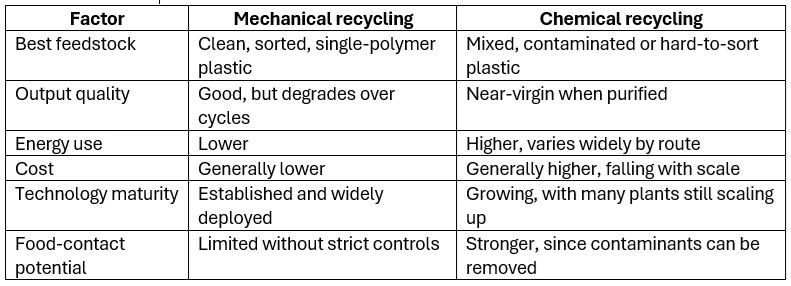
Neither column wins outright. The better question is which one is right for which plastic.
Can chemical recycling handle mixed plastic waste?
This is where chemical recycling for mixed plastic waste earns its attention. Every municipal recycler knows the leftover pile: films, pouches, flexible wraps, black trays, and small items that fall through sorting screens. Mechanical systems often reject them because separating the polymers isn’t economical.
Chemical routes are more tolerant. Pyrolysis, for example, can accept a blend of polyolefins that would be nearly impossible to remelt into a decent pellet. That gives plastics that would otherwise be landfilled or burned a second life.
A fair caveat: “more tolerant” doesn’t mean “accepts everything.” PVC, for instance, releases chlorine that damages equipment and contaminates output, so it has to be removed beforehand. Chemical recycling also isn’t automatically green. The climate benefit depends on how the plant is powered, how efficient the process is, and whether the output ends up as new plastic or as fuel. Only when it goes back into materials does it support circularity.
What about multilayer packaging?
Think of a chips bag, a coffee pouch or a snack wrapper. Each combines several thin layers of different polymers, sometimes with aluminum, to protect food and extend shelf life. They are brilliant at packaging and terrible at traditional recycling, because the layers are bonded together and can’t be separated by shredding.
Recycling technologies for multilayer plastic packaging are one of the most active areas of innovation. The main approaches:
- Delamination and solvent-based separation, which peel or dissolve layers apart so each polymer can be recovered.
- Pyrolysis and other thermochemical routes, which treat the layers as a blended feedstock.
- Design for recycling, the less glamorous but most effective fix: shifting to mono-material pouches (all PE or all PP) that mechanical recyclers can actually process.
In practice, the cheapest multilayer problem to solve is the one you never create. Technology helps with today’s waste, while smarter design prevents tomorrow’s.
Which advanced recycling technologies suit plastic packaging?
Packaging is the biggest challenge because it is the biggest category: short-lived, often contaminated, and made from many formats. Advanced recycling technologies for plastic packaging work best as a layered strategy:
- Rigid, clean packaging (bottles, jars, tubs) goes mechanical. It is efficient and proven.
- Flexible films and pouches can go to improved mechanical lines if they are mono-material, or to chemical routes if they are mixed.
- Food-grade needs may call for solvent purification or depolymerization, where a very high level of purity is required.
- Residual mixed fractions that no one else can use are a natural fit for pyrolysis.
Matching the stream to the process is what keeps both cost and environmental impact in check.
Why recycled plastic quality matters in manufacturing
Technology only succeeds if someone buys what it makes. Recycled plastic quality in manufacturing is the deciding factor, and manufacturers care about specific things: consistent melt flow, color, odor, mechanical strength, and the absence of unwanted substances.
Mechanically recycled resin is perfectly suited to many uses: crates, pipes, furniture, construction products, non-food bottles and textiles. But brands making food packaging, medical products or high-performance parts often need something closer to virgin quality. That is where chemically recycled or solvent-purified material comes in.
Quality problems also create a vicious cycle. If buyers don’t trust recycled content, they won’t pay for it, and recyclers can’t invest in better equipment. Reliable specifications, transparent testing and certification schemes help break that cycle.
Building a circular supply chain for plastics
The real prize isn’t picking a winner. It is stitching these technologies into a circular supply chain for plastics, where material flows back into products instead of leaking out of the system. That chain has several links:
- Design. Products made for recycling (single material, minimal additives, easy-to-remove labels).
- Collection. Clear, consistent household and commercial collection, because quality starts at the bin.
- Sorting. Smarter sorting that routes each stream to its best process.
- Recycling. Mechanical first wherever it works, chemical for what mechanical can’t handle.
- Demand. Brands and manufacturers committing to buy recycled content, which gives recyclers the confidence to invest.
- Transparency. Traceability systems that show where recycled material came from and how it was made.
Weakness in any one link limits the others. The best chemical plant in the world is stranded without feedstock, and the best collection scheme is wasted without buyers.
The honest challenges
A balanced picture needs a few uncomfortable points:
- Scale and cost. Chemical recycling has to prove it can be economical at industrial scale.
- Energy and emissions. Results vary by technology, and independent life-cycle assessments matter more than marketing claims.
- Mass balance accounting. Some projects blend recycled and fossil feedstock and allocate “recycled content” on paper. Clear, auditable rules are essential for trust.
- Waste hierarchy. Recycling, however advanced, sits below reducing and reusing. No technology replaces using less plastic in the first place.
Acknowledging these limits isn’t a knock on the technology. It is what makes the technology credible.
So, mechanical or chemical?
If you want the one-line answer: use mechanical recycling wherever plastic is clean and sortable, and chemical recycling where it isn’t. They are partners covering different parts of the plastic waste stream.
The future of recycling probably looks less like a single breakthrough and more like a well-run relay: better design, better sorting, and the right process for each material. Do that well, and plastic stops being a waste problem and becomes a resource we keep using.
Frequently asked questions
What is the main difference between mechanical and chemical recycling?
Mechanical recycling physically reshapes plastic by shredding, washing and melting it. Chemical recycling breaks plastic down into molecules or monomers that can be rebuilt into new plastic.
Is chemical recycling better than mechanical recycling?
Not universally. Mechanical recycling is generally cheaper and less energy-intensive for clean, single-polymer plastics. Chemical recycling is better suited to mixed, contaminated or multilayer waste and high-purity applications.
Can all plastics be chemically recycled?
No. Some plastics, such as PVC, create processing problems and usually need to be removed first. Performance also depends on the specific technology.
Why is multilayer packaging hard to recycle?
Its layers of different materials are bonded together and can’t be separated by standard shredding and washing. Solutions include delamination, chemical routes and redesigning to a single material.
What is a circular supply chain for plastics?
It is a system in which plastic is designed for reuse, collected, sorted, recycled and bought back by manufacturers, so material keeps circulating instead of becoming waste.
 Media Pack Download
 Newsletters
 Industrial Events