Post-Consumer Recycled (PCR) Plastics: Driving Sustainable Packaging and Manufacturing Innovation
-Plastics.webp)
Every shampoo bottle, detergent jug, and water bottle you've tossed in a recycling bin had a future. Increasingly, that future is a new package on a store shelf. This is the story of post-consumer recycled (PCR) plastic, and it's changing how brands think about packaging.
If you're a brand owner, packaging engineer, or procurement manager trying to figure out where PCR fits, this guide covers what it is, how it's made, how it compares to virgin plastic, and how to source it without the nuisances.
What Is Post-Consumer Recycled Plastic?
Post-consumer recycled (PCR) plastic is plastic that has already been used by a consumer, collected through recycling programs, and reprocessed into a raw material for new products.
Think of a milk jug you rinsed and put in the blue bin. After it's collected, sorted, cleaned, and melted down, it can become resin pellets, which a manufacturer then molds into a brand-new bottle, tub, or tray.
The key word is post-consumer. The material completed a full life cycle with an end user before being recycled. That is what makes PCR different from other recycled content, and why it carries so much weight in sustainability claims.
What Is PCR Plastic Packaging?
PCR plastic packaging is any package, such as a bottle, jar, tub, tray, cap, or film, made partly or fully from post-consumer recycled resin.
Most packaging today isn't 100% PCR. Brands typically blend PCR with virgin resin, using anywhere from 10% to 100% recycled content depending on the product, the regulations, and the performance requirements. A shampoo bottle might use 50% PCR, while a beverage bottle might go higher.
How Is Post-Consumer Recycled Plastic Made?
Behind every PCR pellet is a surprisingly involved journey. Here's the PCR plastic manufacturing process in plain language:
1. Collection. Used plastics arrive through curbside programs, drop-off centers, deposit-return systems, and informal waste collectors.
2. Sorting. Facilities separate plastics by polymer type (PET, HDPE, PP) and often by color. This is done with a mix of manual sorting and optical scanners that identify polymers using near-infrared light.
3. Shredding. Sorted bales are broken into small flakes.
4. Washing and decontamination. Flakes go through hot washes, caustic baths, and float-sink separation to remove labels, adhesives, food residue, and caps made of different plastics.
5. Drying and extrusion. Clean flakes are melted, filtered to remove remaining contaminants, and cut into uniform pellets.
6. Optional upgrading. For food-grade applications, extra steps such as solid-state polymerization (SSP) for rPET or advanced decontamination are used to meet safety and quality standards.
This is called mechanical recycling, and it is the most common route. A second route, chemical (advanced) recycling, breaks plastic down to its molecular building blocks and rebuilds it. It can handle harder-to-recycle materials, though it is still scaling up and is debated on cost and energy use.
PCR Plastic Packaging Materials
Not all plastics are equally easy to recycle. These are the main PCR plastic packaging materials you'll come across:
- rPET (recycled PET): The most widely recycled packaging plastic. Used in beverage bottles, food trays, clamshells, and increasingly in cosmetics.
- rHDPE (recycled high-density polyethylene): Common in milk jugs, household cleaners, shampoo bottles, and caps. Natural (uncolored) rHDPE is especially valuable.
- rPP (recycled polypropylene): Used in closures, tubs, and containers. Food-grade rPP is emerging but more limited.
- rLDPE / rLLDPE: Used in films, bags, and shrink wrap, though quality consistency is harder.
Among these, rPET and rHDPE have the most mature supply chains. If you're new to PCR, they're the safest places to start.
PCR Plastic vs Virgin Plastic
This is the comparison most buyers care about. Here's a straight look:
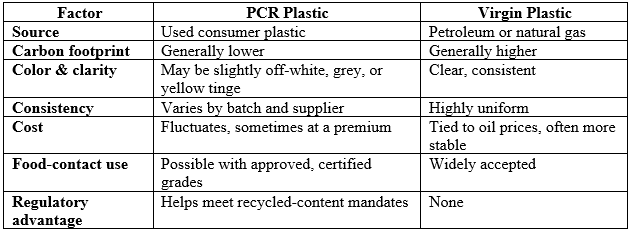
The honest takeaway: PCR is not a perfect one-to-one swap. It needs smart design and supplier testing. But with the right grade, performance often comes very close to virgin, and the sustainability story is far stronger.
Difference Between PCR and PIR Plastic
People mix these up all the time, so here's the short answer:
PCR (post-consumer recycled) comes from products that consumers have used and discarded.
PIR (post-industrial recycled) comes from manufacturing scrap, such as trimmings, off-spec parts, and runners, that never reached a consumer.
PIR is typically cleaner and more consistent because it hasn't been through a household. PCR, though, is what truly diverts waste from landfills and the environment, which is why regulators and sustainability frameworks often give it more credit. If your goal is a credible recycled-content claim, PCR is the stronger option.
Benefits of PCR Plastic Packaging
The PCR packaging sustainability benefits go beyond a green logo:
- Lower environmental impact. Using recycled resin typically reduces greenhouse gas emissions and fossil resource use compared with virgin production.
- Waste diversion. It gives used plastic real economic value, which supports collection and recycling systems.
- Regulatory readiness. Many regions are introducing recycled-content requirements and extended producer responsibility (EPR) rules. PCR helps you stay ahead of them.
- Brand trust. Shoppers increasingly look at packaging when judging a brand's values.
- Supply resilience. Diversifying away from virgin-only sourcing can reduce exposure to oil-price swings.
- Circular economy progress. Every pack that returns as a pack keeps material in use longer.
PCR Plastic Packaging Applications
You'll find PCR in more places than you might expect:
- Beverages: water, soda, and juice bottles (rPET)
- Personal care and cosmetics: shampoo, lotion, and skincare bottles and jars
- Household cleaning: detergent bottles, spray bottles, and caps
- Food packaging: trays, clamshells, and tubs, where food-grade approval applies
- Pharma and wellness: select secondary and non-contact packaging
- E-commerce and industrial: mailers, films, drums, and crates
PCR Resin Specifications for Packaging
Before you order, get clear on specs. Here are the PCR resin specifications for packaging that matter most:
- Polymer type and grade: rPET, rHDPE, or rPP, and whether it's food-grade.
- Melt flow index (MFI) or intrinsic viscosity (IV): these affect how the resin processes. Bottle-grade rPET, for example, needs a specific IV range.
- Color: natural, clear, or mixed. Request a color standard.
- Contamination limits: cross-polymer contamination, moisture, and ash content.
- Odor and volatiles: especially important for personal care and food.
- Food-contact compliance: approvals such as US FDA no-objection letters or EU food-contact regulations.
- Certifications: GRS (Global Recycled Standard), SCS Recycled Content, RecyClass, or ISCC PLUS for mass-balance claims.
Always ask for a certificate of analysis (COA) with each batch and request samples before committing.
How to Source PCR Plastic Packaging
Sourcing PCR doesn't need to feel overwhelming. Follow this simple path:
Step 1: Define your target. Decide your PCR percentage, material, and whether the pack touches food or skin.
Step 2: Check your packaging design. Some designs, like heavy pigments, certain labels, or multi-layer structures, hurt recyclability and PCR performance.
Step 3: Shortlist suppliers. Look for recyclers, resin compounders, and packaging converters who can show traceability.
Step 4: Test samples. Run trials on your filling lines. Check drop strength, clarity, leakage, and shelf stability.
Step 5: Verify documentation. Ask for certificates, chain-of-custody records, and compliance paperwork.
Step 6: Plan for supply. PCR availability can fluctuate. Consider long-term contracts or dual sourcing.
PCR Plastic Packaging Suppliers and PCR Resin Suppliers
There are two broad supplier types, and knowing the difference saves time:
- PCR resin suppliers (recyclers and compounders) produce the pellets. Buy from them if you manufacture your own packaging.
- PCR plastic packaging suppliers (converters and packaging manufacturers) supply finished bottles, jars, and containers with PCR content built in. Choose them if you want a ready-to-fill product.
When evaluating either, ask:
- Can they prove the recycled content with third-party certification?
- What's their batch-to-batch consistency record?
- Do they offer technical support for your application?
- What are their lead times and minimum order quantities?
- Can they scale with you as your PCR percentage grows?
A good supplier acts like a partner, not just a vendor.
Challenges to Plan For
PCR isn't without hurdles, and being upfront about them builds trust:
- Supply variability: quality and availability differ by region and season.
- Aesthetic differences: slight color variations may need design adjustments.
- Cost swings: PCR can cost more than virgin at times.
- Food-grade limits: not every PCR grade is approved for food contact.
The brands that succeed treat PCR as a design decision, not a last-minute material swap.
Frequently Asked Questions
Is PCR plastic safe?
Yes, when it meets the required standards for its application. Food-grade PCR goes through approved decontamination processes and regulatory review.
Is PCR plastic recyclable again?
Yes. PCR packaging can often be recycled again, though quality can decline after multiple cycles, especially in mechanical recycling.
Does PCR plastic cost more than virgin plastic?
It depends on the market. Prices shift with oil costs, recycling demand, and supply. PCR sometimes carries a premium, but regulations and incentives are narrowing the gap.
What percentage of PCR should I use?
Start with what your product can handle, often 25-50%, then scale up as testing and supply allow.
The Bottom Line
PCR plastic isn't a trend. It's becoming a standard part of responsible packaging. It turns yesterday's waste into tomorrow's product, helps brands meet growing regulations, and gives customers something real to believe in.
The best way to start is small: pick one product, test one grade, and work with a supplier who's open about their process. Learn from that trial, then scale.
 Media Pack Download
 Newsletters
 Industrial Events