
Renewable Energy Integration in Plastic Manufacturing Facilities
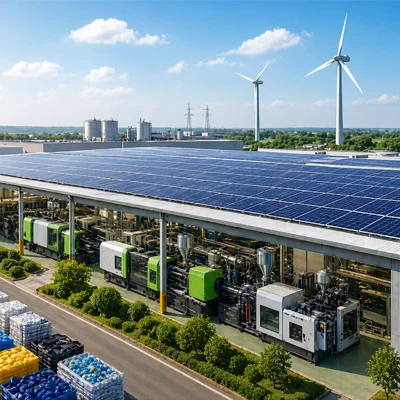
In most plastic manufacturing plants, energy isn’t something you think about once — it’s something you deal with every single day. Machines don’t stop, heaters keep running, compressors kick in at odd hours, and the electricity meter never really slows down.
This has been an accepted part of the business over the years. However, in the recent past, this attitude has begun to change.
The trend behind the interest of more manufacturers in Renewable Energy in Plastic Manufacturing is not that it is a trend, but rather that the old method is becoming increasingly difficult to maintain. Power costs fluctuate, outages affect production schedules, and clients — especially international ones — are asking uncomfortable questions about carbon footprint.
So instead of treating energy as a background expense, companies are beginning to treat it as something they can actually control.
The Shift Isn’t Sudden — It’s Gradual
No plant wakes up one day and switches entirely to green power. That’s not how this works.
The Energy Transition in Plastic Processing Plants is usually slow and practical. It usually begins with a mere realization: too much energy is wastage.
At the first thought of renewables, many facilities start by repairing fundamentals inefficient machines, heat loss, running time. It is after that that the discussion shifts to Sustainable Plastic Manufacturing Energy Solutions.
It is this gradual process, which makes the transition viable, particularly to middle-sized manufacturers who cannot invest heavily in the initial stages.
| Also Read: Regulatory Drivers Pushing Energy Efficiency in Plastic Manufacturing |
Solar: The First Real Step
If you visit a few industrial areas today, you’ll notice a pattern — more rooftops covered with solar panels than before.
That’s because Industrial solar power systems are usually the easiest entry point. The setup is relatively straightforward, and the returns are easier to estimate compared to other renewable options.
In plastic plants, where a lot of production happens during the day, solar energy can directly support operations. It doesn’t eliminate grid usage, but it reduces it enough to make a noticeable difference.
For many businesses, this is their first real move toward Green Energy for Plastics Industry — something tangible, not just a policy statement.
Where It Gets Complicated
Things become a bit more complex when plants run in multiple shifts.
Solar alone can’t cover night operations, and that’s where discussions around solar and wind energy integration in plastic processing plants start coming in. Wind energy isn’t suitable everywhere, but in the right locations, it adds another layer of reliability.
Some companies are also testing storage systems, although not all are convinced yet. Batteries still add to costs, and not every plant sees immediate value.
So instead of going all-in, many manufacturers are experimenting — adding small capacities, observing performance, and scaling slowly.
Efficiency: The Part Nobody Can Skip
There’s a practical truth most experienced engineers agree on — if your process is inefficient, renewable energy won’t fix it.
That’s why Energy-efficient polymer processing is usually addressed alongside renewable adoption.
Sometimes the changes are straightforward:
- Replacing older machines
- Adjusting process temperatures
- Reducing unnecessary idle cycles
Individually, these may not look significant. But together, they reduce overall demand — which makes renewable integration much more effective.
It is not the most thrilling part of the transition but it is likely to be the most significant.
Technology Is Helping — Quietly
A lot of improvements are coming from Green manufacturing technologies, though they don’t always get attention.
Modern machines and monitoring systems give much better visibility into energy usage. Plant teams can now see where power is being consumed, when spikes happen, and which processes are inefficient.
This kind of insight changes how decisions are made. Instead of guessing, managers can actually measure and adjust.
That’s where Clean Energy Integration in Manufacturing starts becoming practical — because you’re working with real data, not assumptions.
Moving Toward Lower Emissions
Not every manufacturer is aiming for full Carbon-neutral plastic production right away. It is not the most thrilling part of the transition but it is likely to be the most significant.
An increase of part of the energy load to renewable sources already makes a difference. Add to that, efficiency improvements and you can measure the effect. In some cases, customers are pushing this change. Large buyers want to know how their suppliers are managing emissions. That pressure is slowly filtering down across the supply chain.
What’s Actually Changing on the Ground
When you talk to plant owners or operations heads, the conversation isn’t just about sustainability anymore.
The benefits of renewable energy in plastic production industry are showing up in everyday operations:
- Power bills are becoming more predictable
- Dependency on the grid is slightly lower
- Production disruptions due to outages are easier to manage
None of this is dramatic on its own, but together, it improves stability — and that matters a lot in manufacturing.
Nevertheless, Not an Easy Decision.
Regardless of the benefits, there are reasons why not all manufacturers are completely ready.
Cost is the obvious one. Even though solar prices have dropped, it’s still a capital decision.
Space is another issue — not every facility has enough usable area for installations.
And then there’s the uncertainty. Renewable energy output isn’t constant, and not all plants are comfortable relying on it.
So the transition continues, but at different speeds for different companies.
Beyond Energy: A Bigger Change
It’s also becoming clear that renewable energy is just one part of the story.
To truly achieve Sustainable factory operations, manufacturers are looking at multiple areas — material usage, waste reduction, process optimization.
Energy is just the most visible starting point.
But once companies begin there, it often leads to broader changes across the plant.
Where the Industry Is Heading
With the current trends, it is likely that a few things will happen:
- More plants will adopt Industrial solar power systems, even if at small scale
- Hybrid setups combining different energy sources will increase gradually
- Focus on Energy-efficient polymer processing will remain strong
- Some large manufacturers will push closer toward Carbon-neutral plastic production
What’s driving all this isn’t just pressure — it’s practicality. The economics is slowly coming together to achieve sustainability goals.
Final Thoughts
The fact that Renewable Energy in Plastic Manufacturing is not a single-time change. It’s happening through small, practical decisions made on factory floors.
A few panels installed this year. A machine upgrade next year. Maybe a storage system later.
Individually, these steps may not look significant. However, in the long run, these accumulate.
And since an industry that works on small margins and continuous production will need minimal changes in energy efficiency and reliability, any such improvements can be a difference-maker.
 Media Pack Download
 Newsletters
 Industrial Events