Understanding the 7 Main Types of Plastic: Properties, Uses, and Environmental Impact
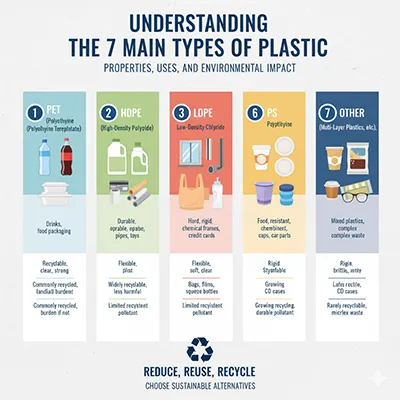
You constantly come across plastics in your day-to-day life, the bottle of water you hold on your hand, the dash board of your car. Plastics have revolutionized industries, packaging and consumer good since it is one of the most versatile materials that has been invented in the 20th century. Nevertheless, despite the fact that there are more than 400 different types of plastics, it is important to know the 7 major types of plastic in order to make the appropriate decisions, particularly in the field of plastic classification, recycling plastic and the environmental effect of plastics. These seven are those which are identified by the plastic identification codes (the triangular recycling signs which are familiar to us and are numbered 1 to 7), which contend with over 90 percent of the entire plastic production in the world.
This ultimate guide divides down each type, its specific characteristics, the frequent applications of PET plastic in the packaging process, and other aspects, provides the real-life applications, and discusses the aspects of sustainability issues. No matter whether you are a consumer with the intention of recycling materials in the best way or a business that may be trying to optimize on materials used, understanding plastic types will enable you to cut down on waste and encourage sustainable behavior. As the world has already surpassed 400 million tons of plastic per year in yearly output (according to the UN Environment Programme data, 2024), the lifecycle of plastics is more than ever important to understand.
Introduction to Plastic Classification and Identification.
It is time to define plastic classification, before getting into details. The most common types of plastics are thermoplastics (plastics which become soft in heating, and can be re-modeled again) and thermoset (plastics which become hard forever once they are cured). All the 7 primary types of plastic are thermoplastics, made standard by the Society of the Plastics Industry (SPI) in 1988. They have a plastic identification code (Resin Identification Code or RIC) between 1 and 7 that products are embossed with so that they can be sorted.
Through these codes, the recycling of plastics is made possible because the materials are directed to the right facility. Not everyone can be recycled though with a wide range at above 30 percent success being only acquired by PET and HDPE. Environmental plastic effects are also uneven: on the one hand, it is possible to produce products that are light and hardy; on the other hand, bad waste adds to 8 million tons of pollution of the sea each year. After interpreting such symbols, you will have a chance to make sustainable decisions.
Now we shall see what each type it has.
1. Polyethylene Terephthalate (PET or PETE) - RIC#1.
Properties: PET is a lightweight, strong, and clear thermoplastic, which has the best gaseous and moisture barrier properties. It is tensile-strong (up to 200 MPa) and it melts at 260degC, hence is convenient in blow-molding. It is non-toxic and FDA approved as a food contact.
Applications: Applications of PET plastic in packaging in packaging, PET has been used mostly dominative (80 percent) in beverage bottles (e.g., soda, water). It is also applied in textile fibers (polyester clothing), blister packages and medical equipment such as IV bags. In 2024, the world reached 83 million tons of PETs.
Environmental Impact: Highly recyclable--PET bottles have a high level of recyclability of over 50% of the bottles are also recycled to produce new bottles or fibers. But the virgin PET is petroleum based adding to 3.4 kg CO2 per kilogram. The most common form of down cycling is converting waste into less valuable products (such as carpets) but chemical recycling technologies are bridging the gap and landfill wastes have dropped by 25 percent in Europe.
Recycling Tips: Find the symbol amount 1; rinse with before recycling to prevent contamination.
2. High-Density polyethylene (HDPE) - RIC 2.
Characteristics: HDPE is a rigid and opaque and chemically resistant with a density of 0.94-0.97 g/cm3. It has the highest impact strength (no break 500 J/m) and UV-resistance, to withstand temperatures ranging between -50degC to 120degC.
Applications: Common in household product materials types of plastic: milk jugs, detergent bottles, toys, and pipes. In construction, HDPE pipes are used to carry water without any form of corrosion. It is even in grocers and cutting boards.
Environmental Impact: The recycling rate of the most used plastic (#2) is 30-40. The low carbon footprint of HDPE (1.8kg CO2/kg) and strength minimize replacements. Nonetheless, shedding of micro plastic plates by bags contaminates waterways. Sugarcane-based bio-HDPE reduces the emissions by 70%.
Recycling Tips: HDPE is picked-up Curbside programs south: HDPE is gathered as flakes; those sorted into a new bottle consume 80% less energy than virgin production.
3. Polyvinyl Chloride (PVC) - RIC #3
Properties: PVC is flexible or rigid (with the use of plasticizers such as phthalates). It has flame resistance and resistance to abrasion and service life of more than 50 years. Tensile strength is 50Mpa; it can withstand -15degC to 60degC.
Applications: out of plastic classification, PVC has an application in construction (pipes, siding, and flooring) and medical tubing. Raincoats, cables and inflatable toys are made using flexible PVC. Only 5% of packaging in the world contains it such as cling wrap.
Environmental Impact: Hazardous because of additives that are toxic; incineration has the emissions of dioxins and production emits 2.5 kg CO2 / kg. The rate of recycling is less than 10% whereby a lot is in landfills. There is a phthalate-free green PVC which minimizes the health hazards, but PVC in the oceans is a leading contributor to 12% of marine trash.
Recycling Tips: Facilities required; do not burn. Recycling of pipes through a mechanical method is giving new pipes.
4. Low-Density Polyethylene (LDPE) - RIC #4.
Properties: LDPE is a translucent and flexible material that is moisture-proof and low-density (0.91-0.94 g/cm3). It is tear-resistant with lower rigidity than HDPE and can work at temperatures between -50degC to 80 deg C.
Application: It is used in squeeze bottles, bread bags and shrink wrap. In the farming business, it goes by the name greenhouse film, whereas six-pack rings remain rings in the retail business.
Environmental Impact: Recycling rate =5 per cent; it will last 500 and more years in landfills. Production emits 2 kg CO2/kg. Past forms of bio-LDPE degrade at 90 times a higher speed, reducing environmental effects of plastics.
Recycling Tips: Dropping locations; recycled in boxes and movies.
5. Polypropylene (PP) - RIC #5
Properties PP is tough, fatigue-resistant and chemically inert and its melting point is 160 deg C. It is flexible (five mega psi) and microwave safe.
Applications: In food container, bottle tops, automobile components and diaper types of plastics. Its sterility is made evident with medical syringes and lab ware.
Ecological Impact: 15 percent recycled; long-lasting structure reduces waste. Emissions: 1.7 kg CO2/kg. Ocean PP is transformed to micro plastics, which damages aquatic life.
Recycling Tips: Acceptable; turns into cases and trays of batteries.
6. Polystyrene (PS) - RIC #6
Properties: PS is brittle (rigid) or foam (expanded EPS). PS Rigid PS is transparent; the EPS resistant to 40x more than water. Density: 1.05 g/cm3 (rigid), 15-30 kg/m3 (foam).
Applications: Foam cups, packaging peanuts, cases of CDs. Rigid PS in utensils and toys.
Environmental Impact: less than 5% recycled; EPS pollutes beaches (10% of rubbish). Styrene is a cancer causing agent; town bans such as New York drive substitutes.
Emissions: 3 kg CO2/kg.
Recycling Tips: Minimized; densifiers squeeze EPS of frames.
7. Other Plastics (Miscellaneous) RIC #7
Goods: Catch-all’s polycarbonate (PC) acrylics and nylon, tough and shatter-free (PC: 70 Mpa tensile).
Applications: Baby bottles (PC), eyewear lenses, electronic.
Environmental Impact: 1 percent is recycled; PC BPA is toxic. High emissions (4 kg CO2/kg).
Recycling Tips: Uncommon; see local regulations.
Plastic Recycling: Making Waste Resources.
It is 9% of the world waste that is recycled as plastic (2024 stats). They are mechanical (melting/sorting) and chemical (breaking to monomers). Advantages: Will save 700 million barrels of oil each year. Hurdles: Pollution reduces productivity. Artificial intelligence sorting increases rates by 60% to an extent.
Table: Success by Type of Recycling.
| Type | RIC | Recycle Rate | Common Recycled Products |
| PET | 1 | 50% | Bottles, Fibers |
| HDPE | 2 | 30% | Pipes, Bottles |
| PVC | 3 | 10% | Flooring |
| LDPE | 4 | 5% | Bags |
| PP | 5 | 15% | Auto Bags |
| PS | 6 | 5% | Insulation |
| Other | 7 | <1% | Limited |
The Greater Environmental Effect of Plastics.
The environmental effects of plastics are two sided. Others: half food waste through packaging; lighter automobiles save 10% in fuel. Cons: 14 million tons get into the oceans every year and kill 1m seabirds. Bioaccumulation PET plastic has toxicants in 88% of sea surface. Solutions: PET plastic in packaging is moving to easier-to-recycle mono-materials. Bans on single-use products (EUs 2021 directive) and bio-substitutes reduced the virgin use 20 per cent. Recycled PET enables the saving of 79% of energy (Lifecycle assessments).
Conclusion: Powering Sustainable Decisions.
This is because knowledge in the 7 primary types of plastic, such as the ability of PET to packaging materials and the pitfalls of PS foam, will enable you to steer through plastic classification, enhancing plastic recycling and reduce the impact of plastics on the environment. Checking plastic identification codes, using recycling materials such as PET and HDPE, and policies, we are able to transition our pollutants to circular economies. The future is bright as more innovations such as enzymatic degradation develop. Start now: Recycle your plastics and become a change agent. This way we would be able to rebrand the legacy of plastics as a solution rather than a problem.
 Media Pack Download
 Newsletters
 Industrial Events