Advanced Sorting Technologies in Plastic Recycling: A Deep Dive into the Future of Waste Management
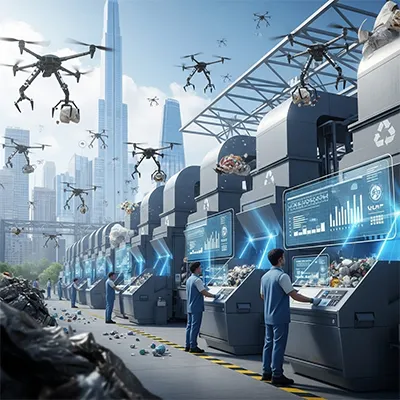
The issue of plastic waste is one of the most current problems of the current epoch. Plastics have infiltrated our entire lives, encompassing names of packaging material and consumer products, and have left mountains of waste that are straining our ecosystem. This is not only an act of a decrease in consumption but also in the way we recycle. The innovative sorting technologies of recycling plastics lie at the very heart of this change, which are transforming the principles of efficiency, precision, and sustainability.
Why Advanced Sorting Matters in Plastic Recycling
One common challenge that has been experienced since the inception of recycling has always been the lack of a proper system to separate mixed plastics into separate streams that are reusable. Poor separation results in pollution of produce, and this makes the recycled materials not useful in high-value applications. The industries that consume high-purity recycled plastics, like packaging, the automobile industry, and consumer goods, have never required them more than they do currently. This has compelled technology developers, researchers, and recyclers to invest in something that transcends mechanical sorting very much.
Nowadays, AI-based waste sorting, optical sorting during plastic recycling, and the introduction of near-infrared (NIR) sensors to plastics allow plants to reach the accuracy levels that were unimaginable ten years ago. The outcome is a world where discarded bottles, films, and containers can be repurposed into new raw materials in an efficient way, and this brings the vision of a circular economy of plastic recycling closer to reality.
AI-Powered Waste Sorting: A Digital Brain in Recycling Plants
So, what will happen when artificial intelligence is introduced to waste management? The solution would be AI-based waste sorting that would directly introduce the power of machine learning and automation to recycling plants. Compared to the manual separation that requires a lot of labor, is prone to error, and slow, AI-powered systems can analyze vast quantities of waste at light speed. Pattern-recognition algorithms, cameras, and sensors monitor even tiny variations between plastics that appear to be identical to the human eye.
The use of deep learning in the identification of polymers is especially revolutionary. These systems are able to differentiate between PET and HDPE, polypropylene, and polystyrene based on training algorithms on massive databases of polymer images and spectral data within milliseconds. The more the system gets to know, the better it gets, and this is the reason why automated plastic sorting systems are continuously adaptive.
This is not only more efficient, but it also makes the industry and the consumer have an eye-catching story. Just think of the power of telling the tale of a shampoo bottle that is recognized, separated, and pumped back into a different bottle production line, all with the help of an intelligent camera and a computer code. Already, recycling turns out to be not only a mechanical procedure but also a wonder of intelligent recycling technologies.
Optical Sorting in Plastic Recycling: Seeing Beyond the Surface
Optical sorting is the foundation of the current recycling facilities in plastic recycling. These are systems based on the light reflection and absorption pattern recognizing materials. As the waste moves past a conveyor belt, light sources and sensors examine the level of reflection and absorption of particular wavelengths by individual objects. According to this analysis, air jets are activated to separate various plastics.
What is really innovative is the use of optical sorting and near-infrared (NIR) sensors on plastics. The NIR technology enables machines to see even more than visible light can, and the molecular fingerprints of polymers are detected. Human eyes can see a transparent bottle, but the NIR sensors can immediately identify the chemical composition of the bottle. The magic lies herein - the separation of plastics not based on color or form but on the properties of the material.
The output? Recycled plastics with high purity that can be put back into the supply chain with little loss of quality. This accuracy is a crucial factor in the market where sustainability is a distinguishing factor among brands and industries to be greener and conform to environmental laws.
Hyperspectral Imaging: A New Dimension in Plastic Separation
When NIR sensors can be seen as the new frontier, hyperspectral imaging for plastic separation is the new jump into the future. Hyperspectral systems, unlike traditional sensors, track a wide range of data covering hundreds of narrow bands, unlike conventional sensors, which track one or two specific wavelengths. This forms a spectral signature of each material in detail, allowing recyclers to distinguish even the most difficult plastics, including black polymers or multilayer films.
Why does this matter? Black plastics commonly used in the automobile and electronic industry are notoriously hard to recycle since they absorb most light and are not detected by the conventional sensors. These materials can no longer go unnoticed using hyperspectral imaging. Recycling plants then suddenly have access to new sources of plastic waste that used to be discarded in the landfills and turn them into useful raw materials.
One wonders with the use of hyperspectral imaging for plastic separation: what other invisible waste streams this technology may be able to reveal? Is it possible to isolate plastics that have additives or trace contaminants with point precision?
Robotics in Recycling Plants: The Hands of Automation
With the development of the brain, the hands develop as well. Recycling. This could be implemented in the recycling plants by introducing robotics that have AI-powered vision systems to sort waste at faster rates than ever. They do not get tired, make subjective mistakes, and they can work with dangerous waste without endangering human personnel.
Combined with AI sorting waste and deep learning to recognize polymers, robots become complete participants in the recycling facility. They are capable of picking, sorting, and putting materials in the appropriate bins with unbelievable accuracy. In addition, robots are also being engineered to have soft grippers and deft motions so that they can manipulate delicate objects without any damage.
This creates an interest in knowing what the future of the recycling workforce will be. Will a new generation of human employees move into supervisory roles, where they oversee the fleets of robots and data systems, instead of being directly involved in working with waste? At that, the recycling plants can become hi-tech spaces where people and machines can work together in the sphere of sustainable resources utilization.
Automated Plastic Sorting Systems: The Orchestration of Innovation
Individual technologies are great in their own merits, but the real strength is in integration. The automated plastic sorting systems are set to manage the interaction between AI, sensors, optics, and robotics. The way to look at them is to think of them as the musicians of a symphony of recycling, with every instrument having a critical part to play in the process of producing the ideal results.
Within a single system, the waste could be subjected to an optical sorting waste in the plastic recycling module, then to NIR sensors on the plastics, after which the waste is subjected to robotic arms to check on the final quality. The outcome is a smooth process consisting of the minimum human input and the maximum of material recovery.
Recycling costing is being redefined by such systems. Increased throughput, reduced contamination, and increased quality output translate to more profitable operations. What is more important is that they prepare the groundwork for the circular economy recycling of plastics so that the materials are constantly recycled into the production process without loss of value.
Deep Learning for Polymer Identification: A Closer Look
We can break now and examine how deep learning is used to identify polymers further. Deep learning models replicate the human brain's pattern recognition as opposed to other algorithms, which are based on set rules because they are rule-based algorithms. They do not simply categorize by color or texture but make up complicated non-linear associations among data.
As an example, we may have a mixed stream of PET bottles and PVC bottles. They are almost the same to the naked eye, but one is food safe and the other is not. These misidentifications can be disastrous in the case of recycling. In the case of deep learning, the system processes thousands of data items in real-time and identifies the minute variances that a human being cannot perceive. The accuracies are higher than the conventional means, and thus, the recyclers are sure to produce high purity of recycled plastics that can be used by industries that require them.
Market Insights: The Economics of Smart Recycling Technologies
An examination of the trends in the market shows why the smart recycling technologies are getting faster in terms of investments. Recent reports state that the world market of recycling plastic technologies will experience double-digit growth in the coming decade. This growth is being driven by regulatory pressure, corporate sustainability, and demand of environmentally friendly products.
| Technology | Adoption Rate (2025 est.) | Key Advantage |
| AI-powered waste sorting | High | Accuracy & adaptability |
| Optical sorting in plastic recycling | Very High | Speed & reliability |
| Near-infrared (NIR) sensors for plastics | Very High | Molecular-level identification |
| Hyperspectral imaging for plastic separation | Medium-High | Detects complex plastics |
| Robotics in recycling plants | Medium | Automation & safety |
| Automated plastic sorting systems | High | Integration & scalability |
These observations will lead to a competitive environment in which recycling firms with sophisticated technologies will have a very high competitive advantage. To the policymakers and investors, the message is clear: plastic recycling of the circular economy is not only an environmental duty but also an economic opportunity.
High-Purity Recycled Plastics: Closing the Loop
The essence of all these innovations is only one thing: to attain high-purity recycled plastics that can effortlessly substitute virgin materials. Industries are increasingly requiring purity of over 95% in an attempt to lower their carbon footprint without necessarily reducing the quality of their products. Whether manufacturing new bottles, in the automotive parts or textile sector, the success of the model of circular economy recycling of plastics depends on the integrity of the recycled plastics.
All innovations - NIR sensors of plastics to hyperspectral imaging of plastic separation - are eventually aimed at this purpose. The capability to manufacture recycled materials of high quality is the key that helps to make the idea of a plastic waste-free world a viable one.
The Road Ahead: What Future Awaits Plastic Recycling?
Recycling is moving towards a trend where it is done in a primitive way of sorting through it to a high-tech dance of AI recycling sorting, robotics at the recycling hub, and an automated plastic sorting machine. Nevertheless, the true interest is in the next step. Can quantum computing be used to identify polymers even better with the help of deep learning? Can we, in the future, recover not only the plastics themselves but also the additives, dyes, and embedded materials in the plastics in future smart recycling technologies?
There is one definite thing: the process of the circular economy plastic recycling has become not an option, but a necessity. And with each new advance in technology, we are one step nearer to a future in which plastics are not garbage, but a resource in an endless cycle.
 Media Pack Download
 Newsletters
 Industrial Events