How AI and Automation Are Actually Helping Plastics Manufacturers Cut Energy Use
Energy has always been one of those unavoidable costs in plastics manufacturing. You don’t really question it—you just try to manage it. Machines need heat, pressure, cooling… and all of that consumes power.
But lately, the approach is shifting.
Rather than posing the question, how do we cut energy, most manufacturers are now posing the question where do we waste energy? It is another question--and it is where AI and automation are beginning to have a tangible effect.
That is also why the debate about AI in Plastics Manufacturing is getting more substantiated. It is not about plants of the future but more about repairing the common inefficiency that people have learned to accept.
Small Inefficiencies Compound at a greater rate than anticipated
If you spend time on a shop floor, you’ll notice something quickly—energy loss rarely comes from one big issue.
It’s usually a mix of smaller things:
A machine running a few seconds longer than needed.
Cooling cycles that are slightly overestimated.
Operators sticking to “safe” settings just to avoid defects.
| Also Read: Renewable Energy Integration in Plastic Manufacturing Facilities |
None of these decisions are wrong. In fact, they’re often made to maintain quality. But over time, they increase consumption.
This is where the idea of Energy Efficient Plastic Manufacturing is evolving. It’s no longer just about upgrading machines. It’s about running existing systems more intelligently.
Automation Helped First—But It Has Its Limits
Before AI became part of the conversation, Automation in Plastic Processing already improved efficiency quite a bit.
Automated systems brought consistency. They reduced manual errors. They made sure processes were followed the same way every time.
That alone helped control unnecessary energy usage.
But automation works on predefined logic. It doesn’t question whether the logic is still valid.
So if a process is slightly inefficient, automation will just repeat that inefficiency very efficiently.
AI Changes the Nature of Control
This is where things start to shift.
With Machine learning in manufacturing, systems don’t just follow instructions—they start learning from outcomes.
For example, an AI system might notice that a particular mold doesn’t actually need as much cooling time as originally set. Or that energy consumption spikes during specific production runs.
These aren’t always obvious patterns. In many cases, they’re too subtle to catch manually.
That’s essentially what Industrial Energy Optimization with AI looks like in practice—not a big overhaul, but continuous fine-tuning.
Real-Time Adjustments Make a Bigger Difference Than Expected
One thing that often gets overlooked is how static most manufacturing settings are.
Once parameters are fixed, they tend to stay that way unless there’s a problem.
But real conditions keep changing—material batches vary, ambient temperatures shift, machines age.
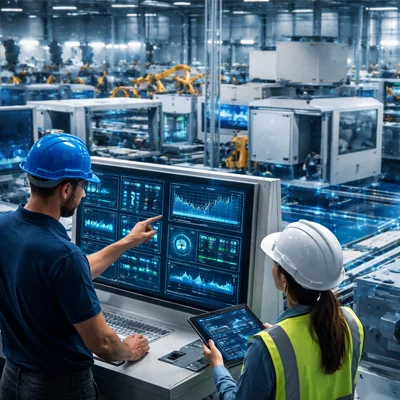
With Real-time process optimization, AI systems adjust parameters on the go. Not drastically, but just enough to stay efficient.
And that’s usually enough.
Instead of running slightly above required energy levels all day, systems operate closer to what’s actually needed.
Injection Molding Is a Good Example
If there’s one area where this becomes very visible, it’s injection molding.
It’s energy-intensive, no surprise there. But it’s also highly adjustable.
That’s why many manufacturers are focusing on reducing energy usage in injection molding using AI.
AI systems can evaluate:
- How long cooling actually takes (not assumed time)
- Whether heating levels are slightly higher than necessary
- If cycle times can be tightened without affecting quality
The savings in others are due to the shaving off of only a few seconds in each cycle.
However, in thousands of cycles that accumulates.
Maintenance is More Important Than You Think
Not all energy waste comes from process settings. Sometimes, it’s the machines themselves.
Equipment doesn’t have to fail to become inefficient. It just has to drift slightly from optimal performance.
That’s where Predictive maintenance in plastics industry becomes useful.
Instead of waiting for something to go wrong, systems monitor performance continuously. Small deviations—like unusual vibration or heat patterns—get flagged early.
Fixing those early keeps machines running efficiently, which naturally keeps energy use in check.
Data Is Finally Being Used Properly
A lot of plants already collect data. The difference now is how that data is being used.
With Industrial IoT in plastic processing, sensors capture everything from cycle times to energy draw.
But raw data alone doesn’t solve anything.
When combined with AI, it starts to tell a story—where energy is going, when it spikes, and why.
That’s essentially what defines Smart Plastic Manufacturing Systems. Not just connected machines, but systems that actually interpret what’s happening.
Looking Beyond Individual Machines
One machine running efficiently is good. But energy savings become more meaningful when looked at across the plant.
That’s where AI-driven energy management in plastic production plants comes in.
Instead of treating each process separately, plants are starting to manage energy as a shared resource.
Some are adjusting production schedules. Others are balancing loads more carefully. A few are even identifying patterns in peak usage that were never analyzed before.
It’s a more holistic way of thinking—and it works.
Sustainability Is Not Becoming Strategic, It Is Becoming Operational
Traditionally, sustainable polymer manufacturing was largely concerned with materials: recycling, alternative polymers etc.
Now, operations are part of that conversation.
If you can produce the same output using less energy, that’s a direct environmental benefit. No change in material required.
And since energy savings also reduce costs, this is one area where sustainability and profitability are actually aligned.
The “Smart Factory” Is Happening Slowly
There’s a lot of talk about smart factory solutions for sustainable plastics manufacturing, but in reality, most companies are getting there step by step.
It’s rarely a full transformation overnight.
It is more frequently in the form of this:
- One production line gets upgraded
- One process becomes AI-assisted
- One system becomes connected
And then it expands.
These small steps gradually begin to interlink and the factory begins to become much more efficient.
Not All Are Up in the Air Yet.
It is worth noting that not all people adopt.
There are manufacturers who are still keen.
The reasons are understandable:
- Upfront costs can be significant
- Integration with older systems isn’t always smooth
- Teams need time to adapt
There’s also a level of trust involved. Letting systems adjust processes automatically isn’t something every operator is immediately comfortable with.
But once results start showing—especially in energy savings—acceptance tends to follow.
So, What Is really changing?
The interesting part is that there is nothing in particular that is dramatic about this.
It has no one-stop solution that will reduce energy consumption by half.
Rather it is the sum of little improvements:
Better settings.
Better timing.
Better maintenance.
Better visibility.
AI and automation just make those improvements consistent.
Final Thought
Energy consumption in plastics manufacturing isn’t going to disappear. It’s part of the process.
What is evolving, however, is the extent of its knowledge--and the accuracy with which it is controlled.
That’s where AI is quietly making a difference.
Not by replacing systems, but by helping them run the way they probably should have all along.
 Media Pack Download
 Newsletters
 Industrial Events