
Smart Mold Technologies: Digital Twins, Conformal Cooling, and Industry 4.0 in Injection Molding
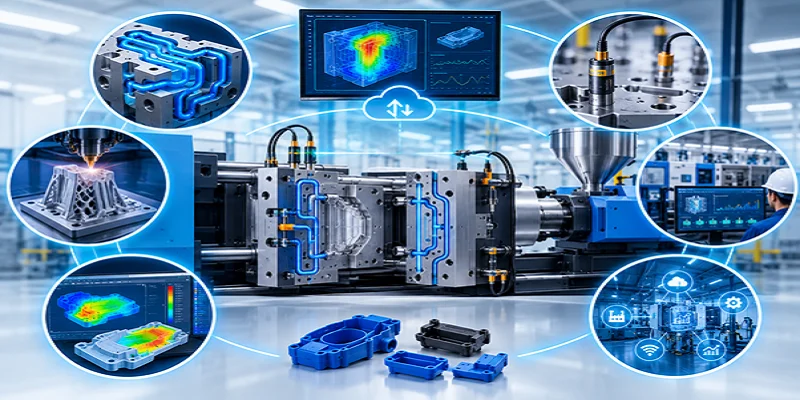
Injection molding has been around for over a century, but the molds themselves are finally catching up to the digital age. Sensors are embedded where there used to be plain steel. Cooling channels twist and curve in ways that would have been impossible to machine a decade ago. And somewhere on a screen nearby, a virtual replica of that exact mold is running, predicting problems before they happen.
This is the world of Smart Mold Technology - and it's reshaping how manufacturers design, build, and run injection molds. If you work in tooling, plastics manufacturing, or product development, understanding these shifts isn't optional anymore. It's the difference between staying competitive and falling behind.
What Is Smart Mold Technology, Exactly?
At its core, Smart Mold Technology refers to the integration of sensors, data connectivity, simulation software, and advanced manufacturing methods directly into the mold-making and molding process. Instead of treating a mold as a static piece of tooling, smart mold systems treat it as an active, data-generating asset.
A Smart Injection Mold typically includes embedded temperature and pressure sensors, communicates with plant systems through IoT protocols, and often has a corresponding digital model that mirrors its real-world behavior. The goal is simple: give engineers visibility into what's happening inside the mold cavity in real time, rather than relying on guesswork, trial-and-error adjustments, or post-production defect analysis.
This shift matters because injection molding has traditionally been a "black box" process. Once the mold closes and plastic is injected, operators have had limited insight into what's actually happening inside. Smart mold systems crack that box open.
Digital Twin Injection Molding: A Virtual Mirror of Reality
One of the most talked-about advances in this space is Digital Twin Injection Molding. A digital twin is a virtual, continuously updated replica of a physical mold or molding process, built from real sensor data, historical performance records, and physics-based simulation.
Here's why this matters in practice: instead of physically testing a new mold design on the shop floor - burning through material, time, and machine hours - engineers can run that same scenario inside a Digital Twin for Mold Design environment first. They can simulate fill patterns, cooling rates, warpage tendencies, and cycle times long before any steel is cut.
Once the mold is in production, the digital twin doesn't stop working. It keeps ingesting live data from the physical mold, comparing actual performance against predicted performance, and flagging deviations. If a cooling channel starts underperforming or cavity pressure drifts outside tolerance, the digital twin can catch it - often before a single defective part rolls off the line.
Manufacturers using digital twins report faster mold qualification, fewer engineering changes late in the process, and significantly reduced scrap rates. It's not an exaggeration to say digital twins have become one of the most valuable tools in the modern toolmaker's arsenal.
Conformal Cooling Injection Molding: Solving an Old Problem
For decades, mold cooling channels were limited by what conventional drilling could achieve - straight lines, right angles, and a lot of compromise. That's where Conformal Cooling Injection Molding changes the game entirely.
Conformal Cooling Technology uses cooling channels that follow the actual contour of the part geometry rather than being restricted to straight-line drilling paths. These channels sit closer and more evenly to the mold surface, which allows heat to be pulled out of the part far more uniformly and efficiently.
The practical benefits are hard to ignore:
- Faster cycle times - because parts cool more quickly and evenly, cycles can often be shortened significantly
- Reduced warpage and sink marks - uniform cooling means fewer internal stresses and dimensional inconsistencies
- Improved part quality - especially critical for complex geometries, thick sections, and cosmetic surfaces
- Lower long-term production costs - even though tooling costs may rise upfront, the cycle-time savings compound over the mold's lifetime
Conformal cooling isn't just a nice-to-have anymore; for high-volume production of complex parts, it's increasingly considered a competitive necessity.
Additive Manufacturing: Making Conformal Cooling Possible
Conformal cooling channels are geometrically complex - often too complex for traditional CNC machining or EDM. This is where Additive Manufacturing for Injection Molds enters the picture.
Using metal 3D printing processes like laser powder bed fusion, toolmakers can build mold inserts with cooling channels that curve, branch, and follow the part's contours in three dimensions. 3D Printed Injection Molds and mold inserts are no longer experimental novelties; they're being used in production tooling across automotive, medical, consumer electronics, and packaging industries.
What makes this especially powerful is the combination of additive manufacturing with simulation. Engineers can design a cooling channel network based on thermal simulation results, print the insert with that exact geometry, and then validate its performance against the digital twin - closing the loop between design, manufacturing, and real-world data.
There are trade-offs, of course. 3D printed mold components typically cost more upfront and require careful surface finishing and post-processing. But for high-value, high-volume, or geometrically demanding applications, the return on investment often justifies the expense.
Intelligent Mold Monitoring: Eyes inside the Cavity
Intelligent Mold Monitoring is what turns a smart mold from a passive tool into an active data source. By embedding sensors directly into the mold - measuring cavity pressure, melt temperature, and coolant flow - manufacturers gain Real-Time Mold Monitoring capabilities that were simply unavailable a generation ago.
Why does this matter? Because most molding defects - short shots, flash, warpage, sink marks - trace back to process variations that happen in milliseconds inside a closed mold. Without direct measurement, engineers are left inferring causes from the finished part. With real-time monitoring, they can see the actual conditions as they happen and make corrections immediately, sometimes through automated closed-loop control systems.
IoT Injection Mold Monitoring takes this further by connecting sensor data to broader manufacturing execution systems (MES) and cloud platforms. This allows plant managers to monitor multiple molds and machines simultaneously, track performance trends over weeks or months, and predict maintenance needs before a failure causes unplanned downtime.
This is Intelligent Injection Mold Technology in its fullest form: sensors feeding data, software analyzing it, and systems responding - often faster than a human operator could react.
Mold Simulation Software: The Engineering Backbone
None of this works without robust Mold Simulation Software. Simulation tools model how molten plastic flows into a cavity, how it cools, where it might warp, and where defects are likely to occur - all before a mold is ever manufactured.
Modern simulation platforms integrate directly with digital twin systems, feeding predictive models with real production data to continuously refine their accuracy. This creates a feedback loop: simulations inform design, real-world data validates simulations, and the combined insight drives continuous improvement in Smart Mold Design.
For toolmakers and part designers, this means fewer physical prototypes, faster time-to-market, and much greater confidence that a first-article mold will perform as expected.
Industry 4.0 Mold Manufacturing: The Bigger Picture
All of these technologies - digital twins, conformal cooling, additive manufacturing, sensors, and simulation - are pieces of a much larger transformation known as Industry 4.0 Mold Manufacturing.
Industry 4.0 is built on connectivity, data, and automation. In the context of mold manufacturing, this means molds that communicate with machines, machines that communicate with plant-wide systems, and systems that use artificial intelligence and machine learning to optimize production continuously - with minimal human intervention required for routine decisions.
The shift toward Industry 4.0 mold manufacturing isn't just about individual technologies; it's about how they work together. A smart mold with embedded sensors is far more valuable when its data feeds a digital twin. A digital twin is far more powerful when it's informed by accurate simulation software. And conformal cooling channels, made possible through additive manufacturing, deliver their full benefit only when monitored and optimized through real-time data.
Frequently Asked Questions
What is the main advantage of digital twin technology in injection molding?
The main advantage is the ability to predict and validate mold performance virtually before physical production, reducing costly trial-and-error, shortening development time, and enabling continuous real-time optimization once the mold is in use.
Does conformal cooling really reduce cycle time?
Yes. Because conformal cooling channels follow the part's geometry more closely than traditional straight-drilled channels, they remove heat more evenly and efficiently, which frequently shortens cooling time - often the longest phase of the injection molding cycle.
Are 3D printed injection molds durable enough for production?
When designed and post-processed correctly, additively manufactured mold inserts can withstand full production volumes, particularly in applications combining conformal cooling with high-performance tool steels or metal alloys suited to additive processes.
How does IoT monitoring improve mold performance?
IoT-enabled sensors provide continuous, real-time data on temperature, pressure, and flow inside the mold, allowing manufacturers to detect anomalies early, reduce scrap, and schedule predictive maintenance instead of reacting to failures after they occur.
Looking Ahead
Smart mold technology isn't a distant future concept - it's already reshaping tooling shops and production floors today. Manufacturers who invest in digital twins, conformal cooling, intelligent monitoring, and Industry 4.0 connectivity are seeing measurable gains in quality, speed, and cost efficiency.
The molds of tomorrow won't just shape plastic. They'll think, communicate, and adapt - and the companies that embrace this shift early will be the ones setting the pace for the rest of the industry.
 Media Pack Download
 Newsletters
 Industrial Events