VACUNITE
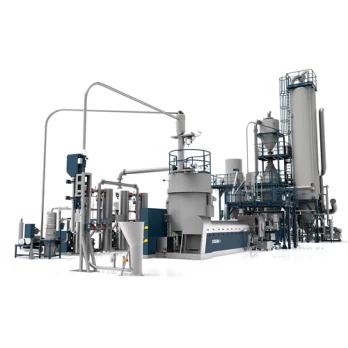
The material moves layer by layer in the direction of the single-screw extruder during the precisely defined residence time. With very low residual moisture of under 0.05% the clean, ideally prepared material enters the intake zone of the extruder.
This material transfer takes place under high vacuum. As a result, no additional degassing ports are required on the extruder itself. This means that the technology drastically reduces the length of the extruder, reduces its energy consumption, improves the colour values (b value) of the processed material and keeps AA values at a very low level. Moreover, the strong homogenisation performance of the extruder plays a significant part in turning the different input IV values into a stable output IV value.
In addition to decontamination and drying, the bulk density increase inside the reactor is up to 100% and the flakes are crystallised. This allows the extruder to be fed in a constant flow – an essential prerequisite for consistent throughput rates.
ZONE 1: removal of the outer moisture of the PET flakes.
The amorphous, washed flakes which enter Zone 1 via a vacuum sluice initially still have widely varying external moisture (between 0.5 and 1%). This is eliminated at around 20 °C under vacuum thanks to the reduced vaporisation point (the inner moisture here is still constant at around 0.3%).
VACUNITE standout feature: Nitrogen flushing
In the VACUNITE system, the sluice and reactor are additionally flushed with high-purity nitrogen (N2, 99.99%). The advantage is that this significantly reduces the residual oxygen content that is responsible for irreversible yellow discolouration.
ZONE 2: the temperature rises from 20 °C to 190 °C.
Thanks to the constantly rising temperature the polymer structure opens up and the process for removing the migration substances and the internal moisture from the flakes begins. This dehumidification stage reduces IV loss.
ZONE 3: the flake decontamination and removal process reaches full effectiveness.